
Statement of Jill Savitt, CEO of The National Center for Civil and Human Rights

We start our week against a backdrop of pain and injustice in our country because of the recent murders of black men and women by vigilantes and law enforcement. There is deep suffering all around us. This despair is showing itself in protests that have included violence—because of a lack of justice and accountability for these murders. Like racial discrimination more broadly, this injustice is not new – it has been with us from the founding of our country. The murders of Ahmaud Arbery and George Floyd and Breonna Taylor are just the most recent reminders that we live in an unjust and unequal society. Had some of these deaths not been captured on film, many people would have just gone on with our lives, as we have so many times before. The explosion of outrage we are seeing in cities across the country is the predictable result of unpunished crimes. The Center believes nonviolence is always the best response – morally and strategically. When making this case himself, Dr. King sheds light on the violence we witnessed over the past weekend. “Riots,” he said, “are the language of the unheard.” This outpouring of rage and grief is not only about the death of George Floyd and Ahmaud Arbery and Breonna Taylor, it’s about Eric Garner and Trayvon Martin and Tamir Rice and what has become a tragically long list of victims and a policing community that has resisted calls, over decades, for reform. It is also about what the coronavirus has revealed to us. Covid-19 has made it starkly clear that some people in our country are safer than others. The individual deaths and the disproportionate impact of the coronavirus on African Americans, on immigrants, and poor people make it deadly clear that one’s security in America is largely determined by your race and your income. These deaths are the results of years of discrimination and disinvestment. That’s not how democracy is supposed to work. Democracy is supposed to recognize everyone as equal before the law, that we are all born with rights and dignity that our government and our law enforcement officials are obligated to protect these rights. In our social contract – the agreement between the government and the governed – our leaders’ most fundamental duty is to keep people safe. Our democracy is broken. The question is, what do we do now? Can we change this dangerous path we are on? The simple answer is yes. There’s no other option. We can and we must. And we know how. The exhibitions in our Center tells the story of how committed individuals transformed our country – ending segregation under the law. They tell how advocates around the world are waging campaigns for freedom. Human rights provide the way forward. But only if we act. The change will only come when we – we, the people, all of us – demand it. Today we launch a campaign – the Campaign for Equal Dignity. Our goal is to galvanize people – you, your friends and family, and their friends and family – to demand equality for all. You can go to equaldignity.org to get started. In undertaking this campaign, we offer a special word for my fellow white people. George Floyd was killed because he was black. The same is true for all of the others I listed earlier. All of their killers were white. White people have a special responsibility right now to demand justice – to make clear these killers do not represent us or our values. Our African American friends and neighbors are tired of doing this work alone. We need to stand together, as human beings and people of conscience. As Dr. King said: “In the end, we will remember not the words of our enemies, but the silence of our friends.” The division and inequality in our country won’t be solved overnight. But I guarantee you it won’t be solved at all unless we act — together — to re-animate our core national values of a government by the people, for the people that demands the promise of equality and justice for all is made real for everyone.
Mari Copeny: More Than A Pageant Queen
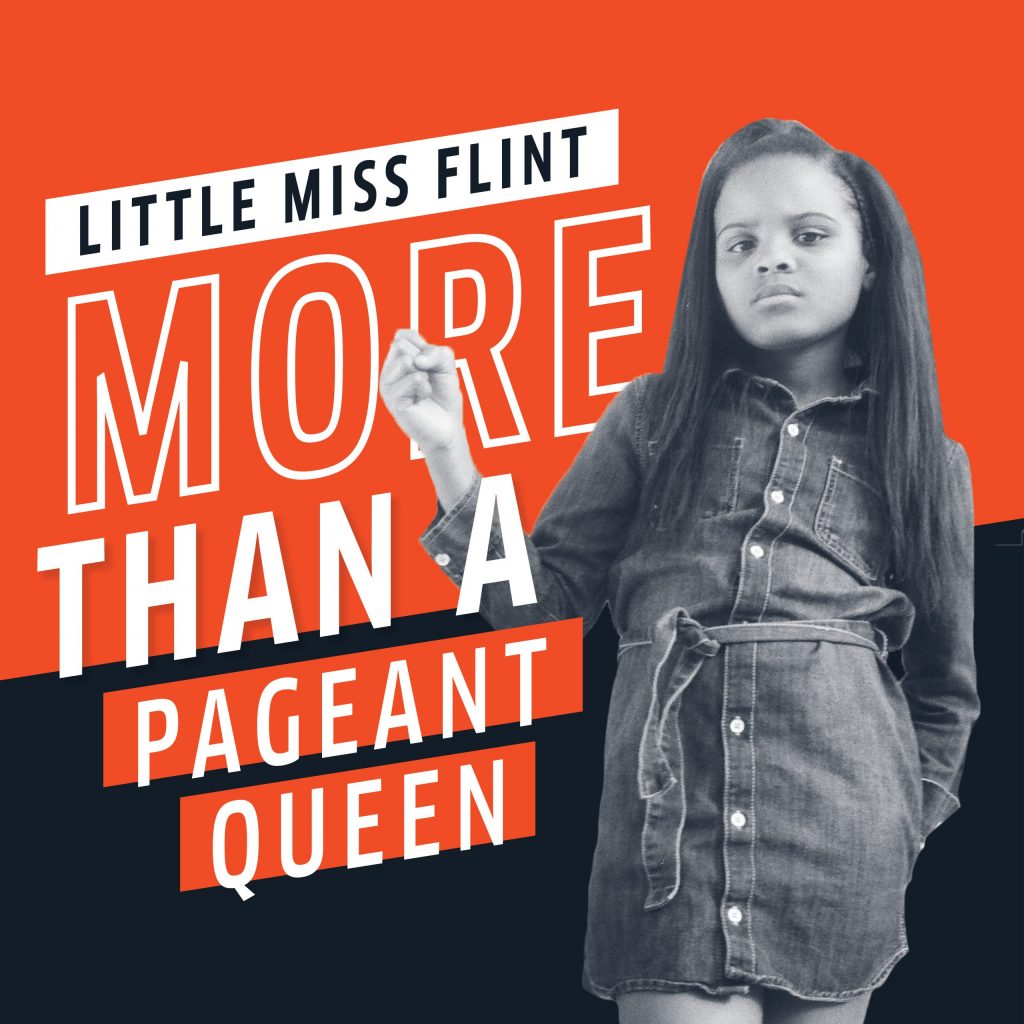
In the small town of Flint, Michigan, in 2016, one child sent a letter to Former President Barack Obama to advocate for environmental change in her community. Unlike many other children growing up in America—she did not have clean water. Her name is Mari Copeny, also known as “Little Miss Flint.” However, she is so much more than a pageant queen. When Mari was young, she participated in pageants, but as she grew and became more aware of her community needs, she became a young activist. Understanding that water & sanitation are human rights, Mari wrote to Obama, who worked with the Michigan state government to eradicate the issue. However, on Friday, April 24, 2020, it will have been six years since Flint had clean water. With this knowledge, Mari has continued fundraising, marching, or lending her voice to say this is not right. Mari could not—and did not—wait for the “adults” to fix the situation. Using her social media networks, she fundraises for water bottles to be donated to her city and participates in Pack Your Back, an organization that donates school supplies to underserved children, and many other community projects for the children of Flint. While she is making amazing strides in her community, we can all do our part to help those in Flint and across the world without access to clean water. Consider following Mari’s #WednesdaysForWater campaign highlighting places around the world that need clean water and donate to the cause. Or even sharing words of encouragement to the #DearFlintKids project. No matter how you help, keep an eye out for Mari as she sets out to change the world. Learn more about Mari Copeny and other Fearless Women at The Center. Experience how we’re more than a museum.
The Voice of an Untamed Heart: Victim of Circumstance amid COVID 19

I woke up this morning to rain falling and echoes of my children talking. It is a normalness that I have been accustomed to but soon I remember that it’s Sunday and I will need to flip on the television or log on to my computer for church service. I admit that I do not go to church regularly but having restrictions of not having the option to put on my Sunday’s best, get in my car, and drive to the brick and mortar for communion is unsettling. Unsettling? There are so many things that are unsettling about our times but in my haste to unscramble my thoughts I remember what is familiar—poverty and inequality. I grew up in a 3-bedroom/1-bath home with 8 other family members. I think about what it felt like to always be in close quarters and how there was no escaping to be alone with my thoughts. There was no central heating or air conditioning so, in the summer, flipping my pillow over throughout the night gave me the illusion that I was cooling off. Having two meals was expected and one came from the free lunch program at school. I remember being in the dark due to no electricity but having one meal that day. Having access to a computer was the furthest thing from my mind and getting access to pen and paper was a challenge at best. I not only think about poverty but inequality and how it is not so different. Not having access to food or space is circumstance but it is also the direct effect of inequality that is deeply rooted in the disproportioned world of African-Americans. So many historical facts and events occurred during or before my childhood. My ancestry is hard to define because of constant tragedy from child lynching to fatal collisions and those events were placeholders that championed poverty. I can remember digging my way out of poverty and fighting to become an educated Black woman with a path to success. Because of inequality and poverty, it did not come easy. Now I see an economy that is crumbling and that more than 30% of African-Americans make up the COVID 19 cases in the U.S., according to the Center for Disease Control and Prevention. Let’s be real, this is a direct reflection of working frontline jobs that barely make ends meet that can be tied to lack of education, lack of transportation, and many racial inequalities that affect how we function in society. Ralph Emerson said, “Cause and effect are two sides of one fact”. (Gray 293)The truth is, in this country, poverty is an effect of inequality and inequality is the cause of poverty. I see poor children (just like I was) suffering because their parents have been laid off or they have no transportation to get the one meal that is offered through the school lunch program. I see children that have no access to continuing their education at home (which is a requirement in this state—Georgia) because they have no computer or internet access. I see families living in 3-bedroom/1-bath homes shared by 9 people that, once, had hoped to change their environment and circumstance, now, having to choose between having electricity or eating a meal. I also see these same people not having the ability to gain healthcare that can save their lives. What do their futures look like? How do those children become first-generation college students? How do they recover from the Coronavirus without healthcare? We are at war with a pandemic that has robbed us of social and economic liberties. So, as we shelter in place, COVID 19 is a reminder that social and economic liberties have different definitions—that’s all I am saying. We hold these truths to be self-evident that all men are created equal. Right? References: ABC News, ABC News Network, abcnews.go.com/Health/coronavirus-updates-trump-speak-world-leaders-coronavirus-response/story?id=70178711. Gray, Henry David. Emerson: A Statement of New England Transcendentalism as Expressed in the Philosophy of Its Chief Exponent. Nabu Press, 2010.
Greta Thunberg: More Than A Teenager
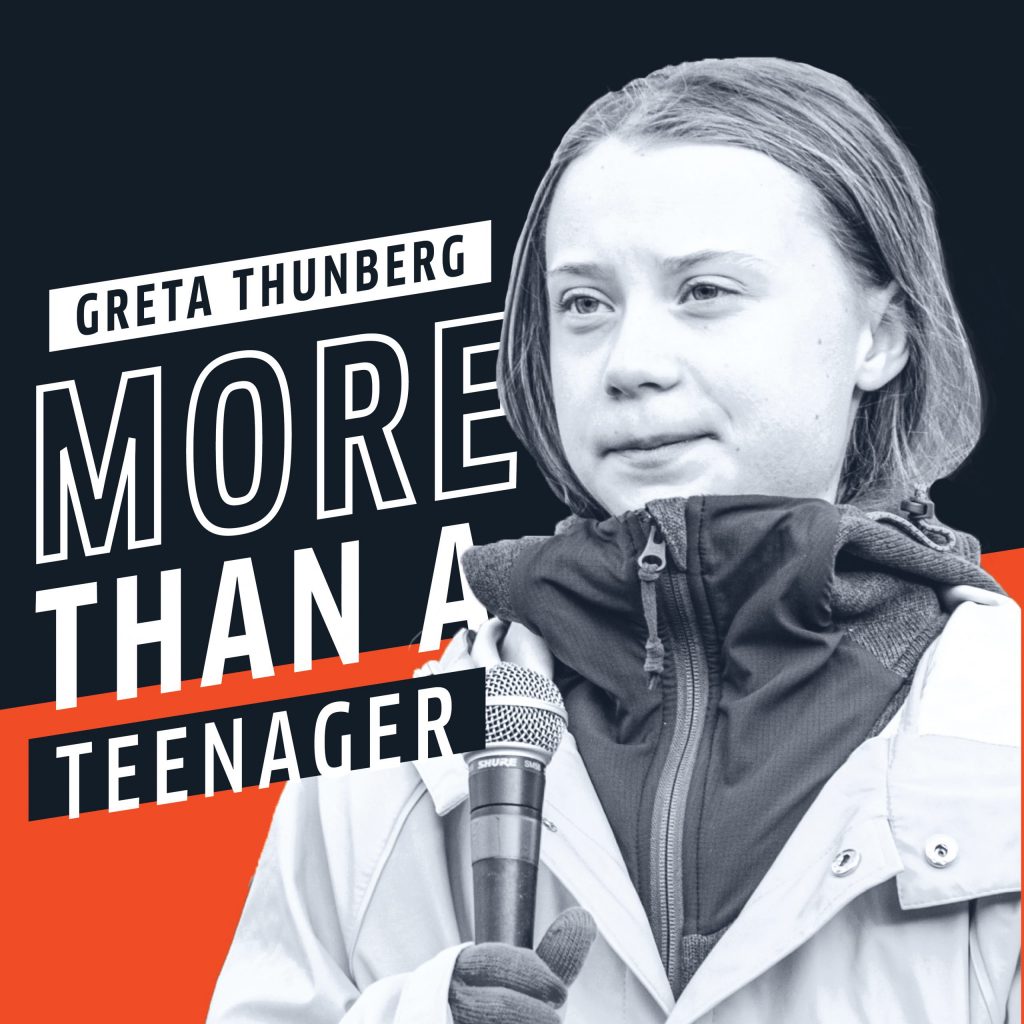
A Swedish teenager ignited a global generational movement to force the world to address climate change. In 2018, Greta Thunberg began her campaign to address the existential threat of climate change by skipping school. Rather than attend class, Thunberg, then 15, spent her school days sitting outside the Swedish Parliament with a sign that said: “School Strike for Climate.” Her goal was to carry out her protest until the Swedish government met the carbon emissions target agreed to by world leaders in 2015 in the Paris Agreement, a landmark global pact setting benchmarks for increasing government action and investment to reducing the use of carbon. From those days, sitting by herself, a movement was born. Media coverage of Thunberg’s protest spread the word — and soon students in other communities and countries launched similar actions. These environmental advocates connected and worked together to organize a worldwide school strike for climate change. Two years after her lonely vigil began, Thunberg had met the Pope, sparred with President Trump on Twitter, and galvanized millions of young people to join and participate in the environmental movement. Last year, Thunberg traveled to the United Nations in New York, by sailboat – to avoid using carbon by flying – to address the 2019 UN Climate Action Summit where she chided world leaders. In an emotional speech, she said: “You have stolen my dreams and my childhood with your empty words. We are at the beginning of mass extinction and all you can talk about is money and fairy tales of eternal economic growth — how dare you!” Thunberg is not only raising awareness, but she also advocates for change. Working with mayors, governors and national decisionmakers, she urges leaders to enact specific policies to slow the pace of climate change. Thunberg has Asperger’s syndrome, a developmental disorder, which causes her to speak with absolute candor. What some people consider a disability, Thunberg calls “a gift” and “her superpower” because it has made her courageous in speaking truth to power about the threats to life on Earth. Learn more about Greta Thunberg and other Fearless Women at The Center. Plan your visit today and experience how we’re more than a museum.
A Note from the Executive Director of IHTI

In critical times, those who are most vulnerable suffer much more than those of us blessed with stable families, support systems, and resources. Some see this as an opportunity to profit off the exploitation of others. During the Corvid-19 pandemic, there are millions of children out of school. Some children are locked indoors with no supervision or, at worst, an abuser. Their parents are facing a mountain of uncertainties. Many are still working, and childcare is not easily accessible. While parents who are at home, are not aware of the increased exposure of their child to predators on online platforms. We can Human Traffick Proof our youth by educating ourselves on how to eliminate the risks online. Please read this article, then act by signing up for free online training at ihtinstitute.org/get-educated schedule to the right. The protection of our children is the International Human Trafficking Institute’s most urgent agenda. View the schedule of events this week.
Let’s Face This Together

Dear Friends of The Center: Our doors have been closed since March 14, and our team misses the in-person interaction with our community. We send strength and love to all of you. Over the past two weeks, we have made a swift pivot to taking our mission and programs online. We’re offering story times and singalongs for kids, organizing education workshops on civil rights history, and hosting a Lunch and Learn series that will introduce you to individuals responding to COVID-19 with a focus on human rights. This is something we need to do individually – and collectively. The coronavirus, and the response to it, raises a range of critical human rights issues: access to health care, to an income, to shelter, to education. It forces us to reexamine the obligations a government has to protect the health and security – the basic rights — of its people as well as the responsibilities we have to each other. The epidemic’s devastating path shows how deeply interconnected we are, and how interdependent. Our response must use this connection, and sense of community, as a strength. Finally, we confront a villain that doesn’t discriminate; COVID-19 attacks people regardless of their race or religion or economic standing. In all the ways we respond, we — and our government — must not discriminate either. Please join us for the conversation (digitally for now!). We will face this together. Best,
Mamie Till: More Than A Mother
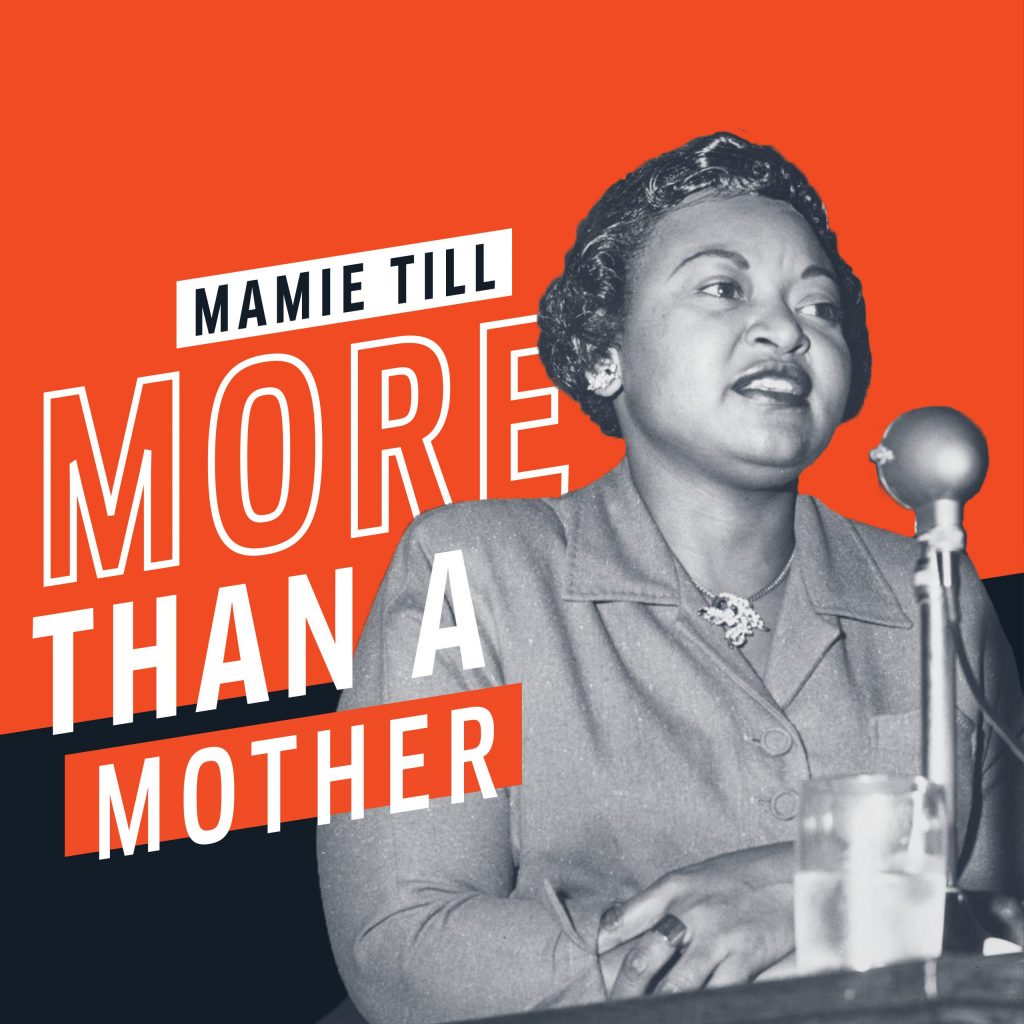
In August 1955, Mamie Till-Mobley tragically became an agent of change when her 13-year old son, Emmett, was murdered while visiting family in Mississippi. Till-Mobley’s decision to show her son’s brutalized body in an open casket served for many as a catalyst to act against the injustices perpetuated against African Americans. Seeing graphic images of his corpse in Jet Magazine and the Chicago Defender made it hard for people to ignore the violence being perpetrated against Black bodies. In fact, her own tragedy served as her own wakeup call as she mentioned in one of her speeches: Two months ago I had a nice apartment in Chicago. I had a good job. I had a son. When something happened to the Negroes in the South I said, ‘That’s their business, not mine.’ Now I know how wrong I was. The murder of my son has shown me that what happens to any of us, anywhere in the world, had better be the business of all of us. After her son’s death, Mamie Till-Mobley became an outspoken advocate in the fight for civil rights, speaking to groups around the country with the NAACP, and serving as an advocate for education. As a teacher in the Chicago Public School system for twenty-three years, Till-Mobley worked with young people both inside and outside of the classroom. She also continued to seek justice for her son in the years following his death, lending her voice to various documentaries and writing an autobiography Death of Innocence: The Story of the Hate Crime that Changed America, that was published posthumously. Learn more about Mamie Till and other Fearless Women at The Center. Plan your visit today and experience how we’re more than a museum. STAY CONNECTED WITH THE CENTER & GET THE MOST UP-TO-DATE INFORMATION ON SOCIAL BY FOLLOWING US @CTR4CHR #FEELTHEPOWER
The Time is Right
In this time of medical crisis and instability, please enjoy this reminder that Atlanta is a strong and vibrant community that can rise to the occasion of any inequity or injustice. Since June 23, 2014, when The Center opened, we have shared stories of struggle and triumph throughout the world. One surprise we’ve discovered along the way is, that when our visitors walk through our galleries, they are often inspired to share their stories. W have so many stories, in fact, that we needed the means to begin collecting them—thus, “The Time is Right” project was born. Working with a group of local professional photographers under the name “#weloveatl,” we sought out the stories of Atlantans who have been or are active in the community working for social justice. During the course of the project, we shot 40 portraits and video interviews of folx from all different walks of life: teachers, mayors, students, business leaders, etc. The film, debuting at the 2017Atlanta Celebrates Photography Festival, is a story of hope, dedication, and love for thy neighbor.
JoAnn Robinson: More Than A Teacher
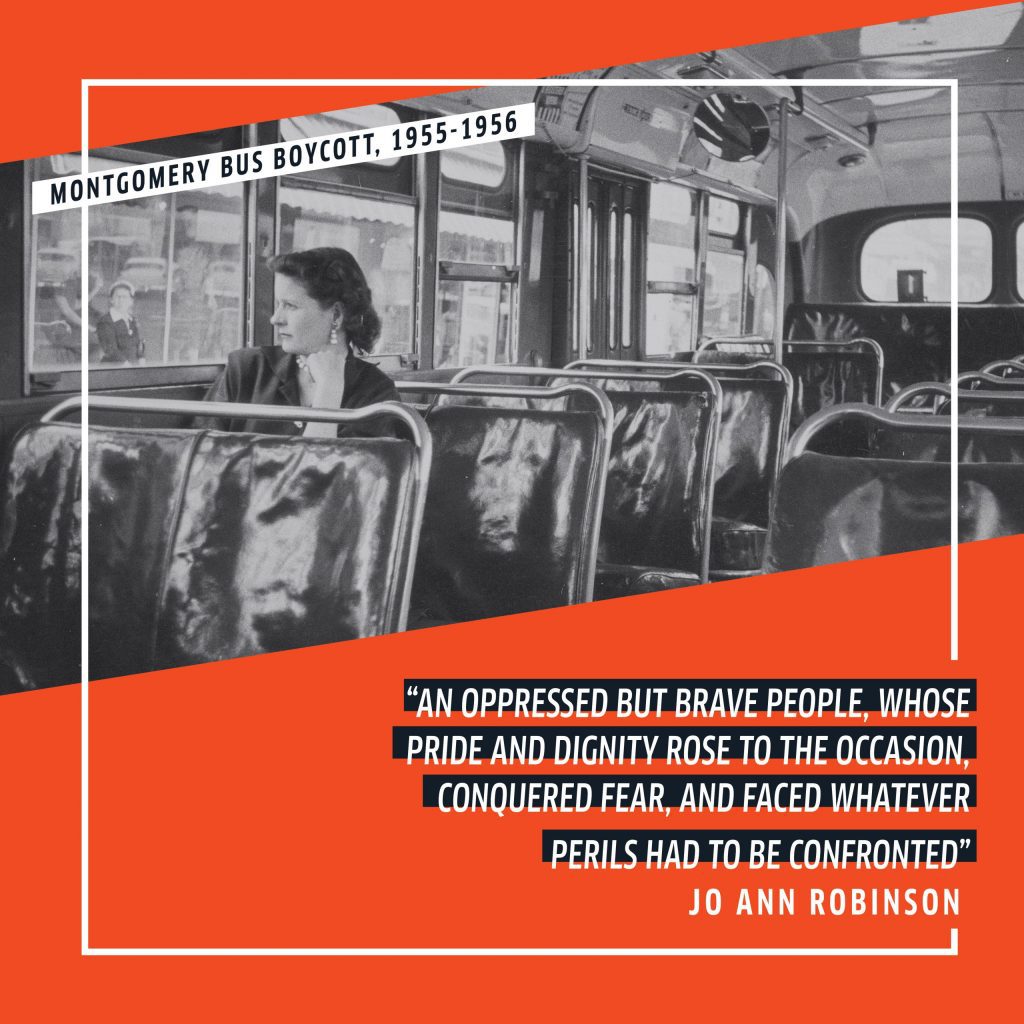
JoAnn Robinson began her career in public service as an educator in Macon, Georgia, working in public schools as an educator. She would go on to earn her master’s degree from Atlanta University and attend Columbia University. A job at Alabama State College for Negroes (now Alabama State University) brought Robinson to Montgomery, where she would join the Women’s Political Council. The WPC was an organization of African American women activists who were faculty of Alabama State College, teachers in the public schools and wives of other African American professionals in Montgomery. These women came together to fight the discrimination and racism African Americans faced on a daily basis. Prior to Rosa Parks’ 1955 arrest, the Women’s Political Council had begun discussing the possibility of a bus boycott. JoAnn Robinson was the WPC president at the time, and met with city officials during 1953 and 1954, pressing them to adopt reforms that would keep segregation in place but no longer require that black passengers surrender their seats to whites. When they received word that Rosa Parks had been arrested the WPC sprang into action. Robinson who was still an English professor at nearby Alabama State College, copied thousands of flyers urging African Americans to boycott buses on the day of Parks’ trial. WPC members canvassed Montgomery’s African American community to spread the word. The one-day boycott proved so successful that the Montgomery Improvement Association (MIA) was formed to direct the movement to change the bus laws. A simple demand that blacks be able to keep their seats evolved into a battle to end segregated buses altogether. The boycott lasted nearly a year, with a U.S. Supreme Court decision finally ruling the Alabama laws unconstitutional. The victory made Martin Luther King, the young president of the MIA, a household name, thanks in large part to the actions and activism of JoAnn Robinson and the Women’s Political Council. Learn more about JoAnn Robinson and other Fearless Women at The Center. Plan your visit today and experience how we’re more than a museum.
A Message from the Executive Director of the IHTI

There is an intersection between sex and labor trafficking. As an example, minors who are sold to Buyers, are also forced to participate in online pornography. This month’s news cycle shined a light on the realities of Illegal Massage Parlors. We see them in strip malls and stand-alone buildings throughout every community, and their illegal core business is hidden in plain view. According to the Polaris Project, there are over 9,000 Illegal Massage Parlors in the United States, generating $2.5b in revenue. There are several differentiating factors between health massage professionals, and Illegal Massage Parlors (IMP). IMP offer massages far below the market rate of legitimate massage therapists. IMPs also offer sexual acts as part of its menu of services. How do you spot an IMP? They are often a locked door at the entrance, as well as, a secondary entrance around the back or the side for their frequent customers; the workers are from other countries with limited English speaking skills. IMPs are operated by a criminal network of owners, who exploit their workers with low wages, crowded living conditions, and little freedom to come and go as they please. IMP’s are a public health and public safety concern wherever they exist. If there is an IMP in your community, other organized criminal activities are taking place. There are two things citizen groups may do: At your next neighborhood meeting, as a group of concerned citizens, ask your local police how do they monitor IMPs and how everyday citizens may support their policing efforts? Contact the Secretary of State office and ask how they regulate Massage Parlors? It was a Florida state Inspector, during a routine visit, who discovered the evidence of human trafficking activities. By only focusing on one aspect of human trafficking, we miss other activities to occur around us, hidden in plain view Onward Deborah Richardson, Executive Director