
Celebrating the Heart of the Center: Honoring Our Volunteers This Global Volunteer Month
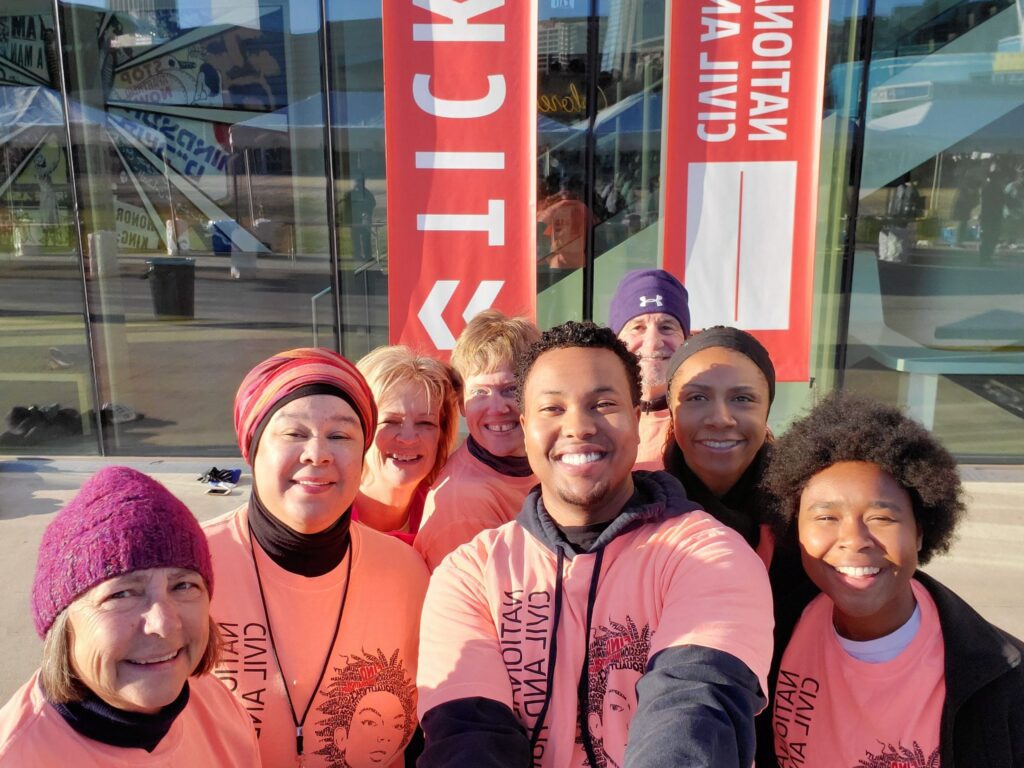
April is Global Volunteer Month and National Volunteer Week is April 19-25th. We want to give a shout to our amazing volunteers who always bring their warmth, empathy, and expertise to the Center. From our reopening in November 2025 to March 2026, our volunteers have given 1,807 hours of service, lending indispensable support to the Center at a critical and busy time. According to Independent Sector, the current estimated national value of each volunteer hour is $34.79, giving their total sum of hours a value of $62,875. We thank each volunteer for giving their time to the Center. You are all greatly appreciated! We are highlighting three amazing volunteers who all started with us at the reopening of the Center: Jason Adeyemi, Robbye Bell, and Karen Singleton. All three of them have earned the NCCHR Bronze Medal for Volunteer Service, having completed at least 100 hours of volunteer service (or 50 hours for teens/juniors). Jason Adeyemi Jason Adeyemi, a high school student, volunteers at the Center because “the center brings powerful stories to life, showing how past struggles for justice and equality continue to influence opportunity and access today. I enjoy helping visitors engage with these connections and think critically about how history impacts the systems that shape our world.” Jason Adeyemi is a co-founder of The Shoeless Ones, a non-profit organization that collects and distributes gently worn athletic shoes to players in youth soccer leagues in the United States and Nigeria. Through this initiative, he’s given over 850 pairs of shoes while leading and organizing donation drives. He also volunteers at the Gwinnett Public Library, where he offers support for children’s programming. He’s an avid soccer player, competing at the highest level through MLS Next with Atlanta United FC’s Academy. Robbye Bell Robbye Bell started as a retiree looking for volunteer opportunities and was intrigued by the prospect of serving at the Center. Robbye says, “I thought that could be interesting. But I never realized what an opportunity and experience it would be. Being surrounded by my past and history that is in this building is truly amazing.” She had previously volunteered for the Atlanta Public School System’s “Everyone Wins” reading program, helping students improve their reading skills. “Volunteering has been a heartwarming experience: creating new bonds and friendships and forging lifelong connections.” Robbye’s excellent customer service skills and dedication to service ultimately led to her being hired. She currently works for our Events department as an Events Assistant. When she’s not working, she enjoys interior design, gardening, learning the piano, and baking. Karen Singleton Karen Singleton heard about volunteering at the Center through a friend, and she’s been a mainstay ever since. Karen loves to interact with our guests and staff while also being surrounded by history. She volunteers for many organizations, including the Bronze Lens Film Fest of Atlanta. Karen says, “Each day that I show up to serve brings me great joy. There is nothing more rewarding than being surrounded by history and connecting with guests to hear their incredible stories.” She has a deep passion for civic service. “I have a servant’s heart; therefore, my daily goal is to be a source of help, inspiration, and warmth to the people I interact with.” When she’s not volunteering, she has many hobbies she shares with her family, including roller skating, bowling, card games, and board games. If you are interested in becoming a volunteer with the National Center for Civil and Human Rights, you can learn more here and apply. We also have volunteer opportunities for corporate groups. Please reach out to Kelly Crosby at [email protected].
Inside The Center June 2024 – LGBTQ+ Institute Spotlight
For this month’s Behind the Scenes, Tim’m West discusses the LGBTQ+ Institute, where he serves as executive director. What makes this program such a valuable resource for our community? The Institute cultivates the next generation of advocates for LGBTQ+ equity. As part of the National Center for Civil and Human Rights, we connect LGBTQ+ history to current advocacy through education, social events, and civic engagement, especially in the US South. Our monthly YOU(th) Belong series supports Atlanta-area LGBTQ+ youth and allies. At the same time, our National Youth Advocacy Fellowship connects emerging advocates with mentors in a variety of fields. At events like our LGBTQ+ Symposium, we engage dynamic and diverse community leaders and organizations committed to human dignity. Our 2024 Symposium, held during Pride Month, drew more than 200 practitioners to share ideas on building a regional network for future advocates. Participants left energized as our work to uphold rights continues year-round amid a hostile climate, with more than 500 anti-LGBTQ+ bills introduced in the US in 2023, many from the South. How did the program start? The Institute began in 2015, a year after The Center opened, with a mission to connect academics and advocates in healthcare, education, employment, and criminal justice. We launched the Southern Survey, one of the most comprehensive studies of LGBTQ+ life in the American South. The Institute was founded on the belief that the narrative of civil and human rights history must include the vital contributions of LGBTQ+ people who shaped these movements. We’ve upheld this commitment for nearly a decade, from our first exhibit on Atlanta’s LGBTQ+ history to recent content featuring leaders like Bayard Rustin and Pauli Murray. What are some of the Institute’s goals this year? With an eye towards supporting, educating, and training our young people in leadership and advocacy, we will solidify our youth programs while preserving the Institute’s research and convening roles. For example, our National Youth Advocacy Fellowship engages high school, college, and post-graduate students in collaborative research that has implications for public policy. Our inaugural Fellowship graduates have tackled projects like a graphic novel about transgender and non-binary students in schools, a photojournalism exhibit on disproportionate homelessness among LGBTQ+ people of color, and a podcast on Queer Labor organizing in Metro Atlanta. How do you see the program’s role at the Center? The Institute is proud to be the place that directly engages Atlanta’s diverse LGBTQ+ community, expanding The Center’s audience. We also emphasize broad allyship through our work—an essential element to support sustainable change and impact, since one-third of young people who participate do not identify as LGBTQ+ but as allies. While centered on LGBTQ+ rights, our programming further connects with movements for racial justice, women’s rights, disability rights, and climate justice. The Institute strengthens support networks and mutual advocacy by fostering alliances among marginalized groups. How can people support your mission? With the rise of anti-LGBTQ+ legislation and its impact on youth mental health, there’s never been a more critical time to support the Institute’s work. You can attend our events, follow us on social media, share our content, and donate to fund our initiatives. We’re also launching a campaign to grow our Bayard Rustin Membership Society and involve members in YOU(th) Belong. As the Institute approaches its 10th anniversary, we are grateful for our supporters who have helped us evolve to address threats to LGBTQ+ equity and inspire new leaders to protect rights and dignity for all.
Inside The Center May 2024 – DEI Experience
For this month’s Behind the Scenes, Philip Polk, Director of The Center’s Diversity, Equity, and Inclusion Experience, discusses the program. What makes this program such a valuable resource for our community? The DEI Experience offers a roadmap for organizations of any size to create a more inclusive environment. Ideally, these cultures treat everyone equitably, combat bias, and embrace diversity. Our customized training sessions promote understanding and empathy, which in turn improve relationships, strengthen networks, and increase civility. Our program is unique in that we apply the lessons of the civil and global human rights movements throughout history to inform our approach to workplace issues. In 2023, more than 5,500 participants from 43 organizations took part in our DEI Experience—companies like Siemens, Chick-fil-A, and the Atlanta Braves, as well as nonprofits like the Girl Scouts of Atlanta, United Way, and Goodwill. How did the program begin? In 2019, The Center convened chief diversity officers throughout metro Atlanta to explore best practices. This forum led to a broader internal conversation about how our organization could share information about DEI. I joined The Center in 2020 after serving as Hallmark Cards’ chief diversity officer. Excited to shape The Center’s DEI program, I developed a curriculum and built a team of facilitators. We launched our first training session in September 2020 with The Home Depot. In our inaugural year, we facilitated 30 client sessions and offered a seven-course curriculum. In 2024, we expanded our curriculum to 18 courses to deliver more tailored training. By the end of this year, we expect to conduct more than 115 training sessions. Our team of six experts conducts presentations on DEI, moderates town hall meetings, and leads small-group discussions. We offer virtual and in-person facilitations. Clients can have sessions at their location or The Center, including a guided tour of our museum. What are some of the near- and long-term goals for the DEI Experience? In the near term, we aim to expand our service area from Georgia to the nation and reach universities, chambers of commerce, and smaller organizations in need. Our long-term goal is to broaden our audience to include anyone interested in DEI. We will introduce a certification program to provide individuals with a robust DEI skill set and to facilitate deeper community engagement. How do you see the program’s role at The Center? DEI Experience is vital to The Center’s mission to inspire changemakers by empowering individuals to transform their workplaces towards inclusivity. Our training exercises equip people to make sustainable changes within their organizations. A prime example is our Brave Space Forum. Participants in this networking lunch-and-learn tackle challenging issues and solutions to shift their workplace culture. These conversations and educational events enhance public awareness of our program and serve as a potent model to heal our communities from polarization and discrimination. How can people support the DEI Experience Program? I encourage people who are passionate about DEI to join our events and tell others to attend. Use your knowledge to help people become changemakers in their communities and organizations. Consider bringing our DEI program to your organization for a facilitated experience. Volunteer to lead tours at our museum and share the importance of DEI. Finally, consider supporting our work through donations to The Center.
Inside The Center April 2024 – Behind the Scenes: K–12 Education Program
April’s Behind the Scenes spotlights The Center’s dynamic K–12 Education Program. Director of Education Nicole Moore shares insights on the upcoming digital NCCHR Learning Portal and offers a glimpse into her team’s ambitious goals for 2024 and beyond. What makes the Learning Portal such a valuable resource for our community? We developed the Portal, in part, to enrich visits to The Center for our K–12 audiences. Educators often lack sufficient time to thoroughly cover many subjects required by state standards. The Portal will enable teachers to enhance their units of study and offer additional content as they prepare for field trips to The Center or debrief students afterward. But we also seek to assist teachers across the country. Our new Portal will engage teachers wherever they are. How did you approach developing the Portal? The idea for the Portal began in 2017 when teachers and students, after visiting The Center, contacted our team for more information about individuals and moments highlighted in the museum. Recognizing this need, we initially envisioned the project as an encyclopedia anchored by The Center’s content. However, as we delved deeper, the concept evolved into a comprehensive digital extension of the museum, offering educational resources online. It’s important to note that these resources encompass diverse primary sources, such as newspaper articles, photographs, speeches, and books. We prioritize objective facts in our content, ensuring the materials provided are informative and reliable for educators and students. How will the Portal work? We’ve invested considerable effort into making the Portal user-friendly and interactive. Upon launch, it will feature an online hub offering free curricular materials that educators can easily download and integrate into their lessons. In the coming year, we will introduce a community space where educators can share resources, continue professional development, and connect with peers. Looking ahead, we aim to incorporate virtual experiences to enhance accessibility to the museum, particularly for students who may face barriers to physical visits. What are the near- and long-term goals for the Education Program? Our near-term goal is to complete Phase One of the Portal with a soft launch planned for this spring for a limited audience. This approach will enable us to gather feedback, collect user experience data, and fine-tune our content before the full launch to everyone in November. Our long-term goals include growing our team by hiring an Education Coordinator to support the department, particularly our Affiliate Partner program. Through this program, we provide educational and professional development resources to students and faculty, such as in-school visits, that extend the impact of our Center experience. Additionally, as our museum expands, we look forward to opening our Civil Rights Teaching Fellowship to a national audience—to build community among teachers nationwide and provide them access to resources and scholars specializing in civil and human rights histories. We strive to be the “go-to” resource for authentic historical materials that promote the truth of history, encourage civic engagement, and foster a deeper understanding of how our past influences our present and future. How do you see the Education Department’s role at the National Center for Civil and Human Rights? We’re the people who bring history alive for students and provide teachers with tools to teach civil rights history by provoking critical thinking about democratic practice and civic participation. We provide context, information, and a space for thoughtful conversations and deliberative dialogue around historical events. As Director of Education, I also see our role going beyond the schools and serving everyone who wants to learn and know more. How can people support the mission of the Education Department? They can utilize our resources, spread the word about our professional development opportunities for educators, and, of course, help fund our efforts. Financial support is vital to continue developing the Portal and its curricular materials.
Inside The Center March 2024 – Supporter Spotlight
Ingrid Saunders Jones is a respected leader committed to empowering communities. She has guided organizations such as The Coca-Cola Foundation, the National Council of Negro Women, and the YWCA of Greater Atlanta. Jones has supported The National Center for Civil and Human Rights since its inception and played a pivotal role in The Coca-Cola Company’s decision to provide land for the museum. Jones served on The Center’s board for 11 years and helped shape the organization’s mission and vision. In 2024, The Center recognized her steadfast dedication by honoring her as its second emeritus board member. For our Supporter Spotlight during Women’s History Month, we asked Jones to reflect on leadership, the significance of mentorship, and what drives her ongoing passion for promoting thriving communities. Why is it important to celebrate Women’s History Month? We must illuminate this history, especially the unsung heroes of the civil rights movement, as The Center did for its 2023 Power to Inspire event. It makes people say, “I didn’t know she was involved,” and want to learn more. I’m so pleased we lifted Myrlie Evers Williams, but there are many more. And we’ve lost so many, like my friend Connie Curry, who worked for Mayor Jackson. Women have been the backbone of many significant Atlanta civic organizations, and it is essential to acknowledge their contributions. Who are some women who have inspired you? There are multitudes, but two major people who immediately come to mind are Coretta Scott King and Alana Shepherd. Coretta started from scratch and said, “We’re going to remember my husband.” She fulfilled that promise and built an institution, creating the King Center and a national park. Alana founded the Shepherd Center after her son sustained a spinal cord injury, realizing that Atlanta lacked adequate care. The Shepherd Center has since provided specialized care for thousands. Who is a woman who personifies leadership? I think of Shirley Franklin’s leadership and her impact on the city of Atlanta. Her knowledge of how to get things done and her ability to partner led to the construction and expansion of The Center. Through her leadership, she was able to convince skeptics and inspire others. Franklin also tackled important infrastructure issues, such as the sewers, during her time as a leader in Atlanta. The Center is one of her many accomplishments, and it serves as a testament to her legacy. How has mentorship influenced your career? Mentorship has always been important to me. Through mentors, there is a direct connection between my role as a nonprofit leader in Detroit and my work for the Atlanta City Council president, going to work for Mayor Jackson, and then working at The Coca-Cola Company. I was directly mentored by my boss, Carl Ware, and indirectly by Chairman Roberto Goizueta. When I speak with young people, the key to earning mentorship is demonstrating a strong work ethic and the ability to get things done. I was learning even if they didn’t know they were mentoring me. What advice have you carried through your career? You’ve got to know what is happening in the world – to engage specifically where you are, but also more broadly to understand critical data so that you can dimensionalize solutions. You cannot live in a bubble. What advice would you give to aspiring leaders? When you become a boss, you are responsible for making everybody who works for you successful. In my career, I was surprised by the number of people who did not understand that. What causes are you passionate about now? Since retiring ten years ago, I’ve slowly but surely narrowed my focus. My passion project is reopening the YWCA Phyllis Wheatley Building to serve as a community epicenter for Atlanta’s Westside, providing daycare and skills training for working parents. The wealth gap in Atlanta is growing, and we must, as a community, be intentional about mitigating that.
Inside The Center January 2024 – Center Behind the Scenes
Two new leaders joined The Center in 2023: Kama Pierce, Chief Program Officer, and Adriana Higgins, Chief Advancement Officer. We asked Kama and Adriana to tell us a bit about themselves. Kama Pierce, Chief Program Officer Kama joined The Center in September 2023, and brings more than 25 years of experience working in civil rights, educational programming, and non-profit and education leadership to her role. Previously, Kama was Senior Vice President of Strategy, Marketing & Communications, for the Woodruff Arts Center. She is also a member of the Leadership Atlanta Class of 2023. During her legal career, Kama served as Assistant Public Defender in Bucks County, Pennsylvania, and as a staff attorney for the Third Circuit of the United States Court of Appeals.” Kama first discovered The Center during her work with a history museum in Charlotte, NC. Upon relocating to Atlanta in 2020, The Center became a top priority on her “must-visit” list in her new city. Kama says her role embodies her ideal of “leading with purpose,” a principle she embraced during her time at Leadership Atlanta. She loves the dynamic daily pace to drive and support the unique goals of our Education, Public Engagement, Initiatives, and Exhibitions teams, each dedicated to inspiring changemakers. Adriana Higgins, Chief Advancement Officer With over two decades of experience in nonprofit fundraising, resource development, and marketing, Adriana oversees The Center’s Development, Marketing, and Communications teams. She has built development and planned-giving programs to increase revenue at organizations like the Houston Zoo, Habitat for Humanity International, Susan G. Komen Breast Cancer Foundation in Houston (where she was CEO), Piedmont Healthcare Foundation, and Measures for Justice. Upon relocating to Atlanta, numerous friends recommended The Center as an essential cultural organization. Adriana was attracted by the opportunity to cultivate national support for an outstanding organization and to spearhead fundraising initiatives to educate future generations. Adriana is grateful for the chance to collaborate with talented colleagues who share her passion for fostering The Center as an exceptional educational hub for civil and human rights history. Kama and Adriana discussed their work as well as life outside of the museum. What do you find most rewarding about your work so far? Kama: Hands down it is the people. That includes working with our dedicated staff; meeting and strategizing with community partners; and striving to uncover, understand, and share the stories of the people from our past. Adriana: Seeing all the students and school groups coming through The Center and knowing this is often due to donor support is rewarding. We always want donors to know that with their support, more students and families can experience free programs throughout the year. What is your favorite part of the museum? Kama: My favorite exhibit changes constantly. In January, I would have to say it is our gallery where we display selections from the Morehouse College Martin Luther King Jr. Collection. Our exhibition and education leaders have collaborated wonderfully with our historian partners to curate our new rotation. This year, we take a deep dive into the events of 1964 which had a profound effect on the civil rights movement. Adriana: Like so many of our visitors, I’m continually inspired by our pre-function floor which puts Dr. King’s words front and center, beginning with our “Fragments” installation. When I walk through the museum, I love seeing young people taking pictures with Dr. King’s words as an inspirational backdrop. How do you like to recharge? Kama: Recharging is a necessity, and I do so by leashing up Baxter, my Lab-mix dog, and hitting the park or road to disappear for a bit with “woman’s best friend.” Adriana: I love music, and I’m most recharged when I listen or dance to Calypso and Soca – preferably at a beach.
Inside The Center January 2024 – Donor Spotlight
Our inaugural Donor Spotlight focuses on Frank Sims and Tom Glenn, the co-chairs of our Building the Vision expansion campaign, and long-time friends of The Center. We asked Frank and Tom to reflect on why they chose to be champions of The Center’s work. Frank Sims Frank retired from Cargill in 2008, where he led major strategic business segments in the United States and internationally. He later served as interim president of Fisk University (2015 to 2017 and 2022 to 2023). Frank served on The Center’s Board from 2015 to 2021. Tom Glenn Tom is a trustee of the Wilbur & Hilda Glenn Family Foundation where he focuses on the foundation’s work in public education, social justice, and human services. He is a former trustee of The Westminster Schools, the Center on Philanthropy at Indiana University, and Children’s Healthcare of Atlanta, among others. Why do you support The Center and why should others? Frank: As a lifelong advocate and supporter of human rights, I continue to support this outstanding museum that tells a powerful story of the civil rights movement and The Center’s programs that inspire changemakers in education, DEI, and more. I tell people that if you share an enthusiasm for human rights or want to learn more, this is the place you want to get involved with! Tom: Justice and dignity for all is essential to sustain local, national, and global communities. I support The Center because it focuses attention on significant historical and current inequities and nurtures efforts to correct these defects in our society. What is your hope for The Center? Frank: I hope and sincerely believe The Center will continue on the path of being recognized regionally and nationally as a premiere cultural organization, convener, and thought leader that inspires respect for the rights of all people, everywhere. We have the resources and leadership to make this a reality. Tom: My hope for The Center is that it can change attitudes, touch hearts, and replace bigotry and hate with compassion.
Women of the Movement to Be Honored at Power to Inspire 2023
Women played a huge role in planning and executing the March on Washington but were nearly unrecognized during the event. This year marks the 60th anniversary of the March, and The Center is hosting a one-night-only performance entitled “Let Us March On…” that will transport audience members back to August 28, 1963, and recognize contributions of the women behind the March. Our honoree this year is Mrs. Myrlie Evers-Williams. Get to know her and the other women of the movement! Myrlie Evers-Williams Myrlie Evers-Williams and her husband, activist Medgar Evers, opened the first NAACP field office in Mississippi. The high-profile activists promoted voting rights, equal justice, and economic equality. Their impact on the community made them targets for racial violence, and Medgar Evers was shot and killed by white supremacists in June 1963. After her husband’s murder, Mrs. Evers-Williams continued the fight for equality and justice. Between 1995 and 1998, Mrs. Evers-Williams served as chair of the National Board of Directors of the NAACP and later established the Medgar Evers Institute in Jackson, Mississippi. Mrs. Evers-Williams’ work has earned her many tributes, including several honorary doctorates. She was named “Woman of the Year” in 1998 by Ms. Magazine and one of the “100 Most Fascinating Black Women of the 20th Century” by Ebony magazine. In 2013, Mrs. Evers-Williams delivered the invocation at President Barack Obama’s second inauguration, becoming the first woman and first non-clergy member to perform the prayer. Frankye Adams-Johnson Frankye Adams-Johnson is an educator, poet, speaker, and author. Growing up in Jackson, Mississippi, she was a prodigious youth organizer who helped organize numerous civil rights events, sit-ins, and marches, including a walk-out of her high school. She joined the Student Nonviolent Coordinating Committee (SNCC) and worked closely with Medgar Evers as well as the NAACP and the Council of Federated Organizations (COFO). She moved to New York state in 1967, where she co-organized a branch of the Black Panther Party in White Plains. She later became a college professor and returned to Jackson where she teaches English at Jackson State University and eventually served as Chair for the Veterans of the Mississippi Civil Rights Movement. Xernona Clayton Brady Xernona Clayton Brady is an American civil rights leader and broadcasting executive. She worked for the National Urban League and Southern Christian Leadership Conference during the civil rights movement. Later, Clayton went into television, where she became the first African American from the southern United States to host a daily primetime talk show. She became corporate vice president of urban affairs for Turner Broadcasting, created the Trumpet Foundation, was instrumental in the development of the International Civil Rights Walk of Fame, convinced a Grand Dragon of the Ku Klux Klan to denounce the Klan, and has been honored by the NAACP and the city of Atlanta for her work. Rutha Mae Harris Rutha Mae Harris channeled her civil rights activism through music saying, “without the songs of the movement, personally I believe that there wouldn’t have been a movement.” She, along with Bernice Johnson Reagon, Cordell Reagon, and Charles Nesbett, formed the SNCC Freedom Singers in Albany, Georgia. They sang in coffeehouses, colleges, theaters, and demonstrations across the U.S to raise money for the movement and share the stories of what was happening in the field. Harris later joined Reagon as part of Sweet Honey in the Rock. Still living in Albany, Harris taught at Monroe High School for 30 years and continues to bring joy and inspiration through song. Joan Trumpauer Mulholland Joan Trumpauer Mulholland is an American civil rights activist who was active in the 1960s. Due to her participation in a 1961 Freedom Ride she was arrested and endured two months in Mississippi State Penitentiary’s maximum-security unit. The following year she enrolled at Tougaloo College in Jackson, Mississippi, as its first white student, representing her belief that integration must be a two–way street. She served as the local secretary of the Student Nonviolent Coordinating Committee. Later, she established the Joan Trumpauer Mulholland Foundation, dedicated to educating youth about the civil rights movement and how to become activists in their communities. Karen Spellman Karen Spellman is a special events producer who formed her company in 1984, specializing in large-scale cultural and social justice programs. Her work in the civil rights movement began as a high school student in the Greensboro, North Carolina, NAACP youth chapter, where she participated in sit-ins for public accommodations. In 1963 she worked with SNCC and the Nonviolent Action Group (NAG). In 1966 she became SNCC’s national research director in Atlanta, Georgia. She contributed to SNCC’s newsletter, created “The Panther’s Claw” newsletter for the Lowndes County Freedom Organization, and produced the Afro American News Service that provided feature articles documenting the work of SNCC to the national Black press. Maria Varela Maria Varela is a Mexican American civil rights photographer, community organizer, writer, and teacher. She was active in many civil rights movements, advocating for indigenous communities and protecting cultural heritage within African American, Native American, and Mexican American communities. She brought a powerful photographic eye to SNCC from 1963 to 1967. Later settling in New Mexico, Varela created and supported several nonprofit organizations to help minority groups and started agricultural cooperatives and community health clinics. She co-founded Ganados del Valle in 1981, a nonprofit economic development corporation dedicated to helping Hispanic and Native American communities preserve their pastoral cultures, lands, and water rights. Learn more about this years Power to Inspire and purchase tickets for the inspiring “Let Us March On…” performance today.
Environmental Justice: The Intersectionality of Race and Human Rights in the Movement
This April, The Center is excited to spotlight race and human rights in the environmental justice movement. More than a focus on clean air and water, or climate initiatives, environmental justice strives to create and maintain a healthy environment for all people, regardless of background. Advocates for ecological equality (as the field is also known) use a range of civic tools to achieve their goals including regulations and policy enforcement, and resolution planning that is inclusive of all audiences. For communities of color, environmental justice is a continuous struggle as statistics show that environmental hazards disproportionately impact minorities. Although the environmental equity movement has existed for more than 40 years, recently there has been a strong push to refocus efforts to improve conditions for at risk communities. Numerous crises continue to ravage low-income and minority areas around the nation. From the Flint, Michigan water crisis and Asthma Alley in the South Bronx to Cancer Alley in Louisiana, thousands of marginalized groups are experiencing adverse health effects due to a range of environmental ills that routinely plague low-income communities rather than wealthier areas: illegal dumping, chemical runoff, and other environmental pollutants. Consider this: Research shows that more than half of the people who live within 1.86 miles of toxic waste facilities in the United States are people of color. (Commission for Racial Justice) 2% of African American children and 4% of Mexican American children are poisoned by lead, compared with 2.3% of white children. (Centers for Disease Control and Prevention) 3 out of 5 African Americans live in communities with uncontrolled toxic waste sites. (NCCJ) Whether by systemic design or institutional subconscious bias, decisions that result in the disproportionate exposure of minority and underprivileged groups to environmental hazards or health burdens is environmental racism. If left unchecked, the proportion of minorities affected by ecological injustice will continue to rise. Access to clean air, water, and a healthful environment are essential human rights. When specific marginalized groups are deprived of these fundamental rights, the offense is not just against these fundamental rights, but includes the abuse of discrimination as well. Although several environmental organizations bring awareness and action to climate and environmental pollutants, few address the intersectional connection between low-income and minority demographics and the environmental injustices that plague their communities. To achieve ecological justice, environmental organizations must be more inclusive in their policymaking. Rather than just providing a space for these issues, organizations must welcome, educate, empower, and support marginalized groups to address the problem. Inclusion of all people from all backgrounds in the work of environmental justice creates more diversity of thought, leads to greater innovation, and increases the capacity for change. The intersectionality of environmental justice and human rights is only the start of the discussion. These issues also intersect with healthcare, equal pay, and economic justice. However, the change starts with acknowledging the problem and collaborating with all stakeholders to break down and reimagine the system. Throughout the month, The Center will continue to highlight the challenges and triumphs of the environmental justice movement, and we invite you to join us on the journey!
Bending The Arc
Jill Savitt is the President and CEO of the National Center for Civil and Human Rights. Our country faces a moment of reckoning on race and justice. As the director of a history museum, I should refine that statement so it is more precise: our country faces yet another moment of reckoning on race and justice. Our museum, The National Center for Civil and Human Rights in Atlanta, tells the history of the U.S. civil rights movement, which was not a moment of reckoning, but a decade—of triumphs and setbacks, victories, and violence. By the end of that era, after a series of legal cases won by determined lawyers and disciplined advocacy waged by thousands of courageous people, Congress passed the Civil Rights Act of 194 and the Voting Rights Act of 1965. To read more, visit The Arthur M. Blank Family Foundation’s website here.