
Sit-In: Supplementary Materials

Sit-In: How Four Friends Stood Up by Sitting Down | Supplementary Materials It was February 1, 1960. They didn’t need menus. Their order was simple. A doughnut and coffee with cream on the side. Courageously defying the WHITES ONLY edict of the era, four young black men took a stand against the injustice of segregation in America by sitting down at the lunch counter of a Woolworth’s department store. Countless others of all races soon joined the cause following Martin Luther King Jr.’s powerful words of peaceful protest. By sitting down together, they stood up for civil rights and created the perfect recipe for integration not only at the Woolworth’s counter, but on buses and in communities throughout the South. Find the book near you. Download the teaching guide provided by Scholastic.
Freedom Summer—Missing Workers

Frustrated by the continued intimidation and violence leveled against African Americans attempting to vote in Mississippi, and by the lack of federal intervention, civil rights organizers developed a new strategy in the summer of 1964. They enlisted large numbers of white college students from around the country to join workers from the Student Nonviolent Coordinating Committee (SNCC), in the hopes of drawing media and federal attention to the situation. SNCC recruited volunteers across college campuses and provided intensive training to make sure the new recruits could endure anti-integrationist Mississippi. On June 16, 1964, the Ku Klux Klan attacked the Mt. Zion Church in Neshoba County, Mississippi, assaulting the congregation and burning the church to the ground. On June 21st, civil rights workers James Chaney, Andrew Goodman, and Michael Schwerner disappeared after meeting with members of the destroyed church. They were murdered by Klan supporters in collusion with local law enforcement personnel and were buried under an earthen dam. Their bodies were not discovered until August 4th, forty-four days later. The long search for the missing activists attracted national attention and “Goodman, Schwerner, Chaney” became a rallying cry. Although reprisals against civil rights workers continued, the case generated national attention and provided added momentum to the pending Civil Rights Act of 1964, which was signed by President Johnson during the 44-day search. Freedom Summer—Missing Workers: Clip on the disappearance of Cheyney, Goodman and Schwerner, featuring Gwendolyn Zoharah Simmons.
Mamie Till: More Than A Mother
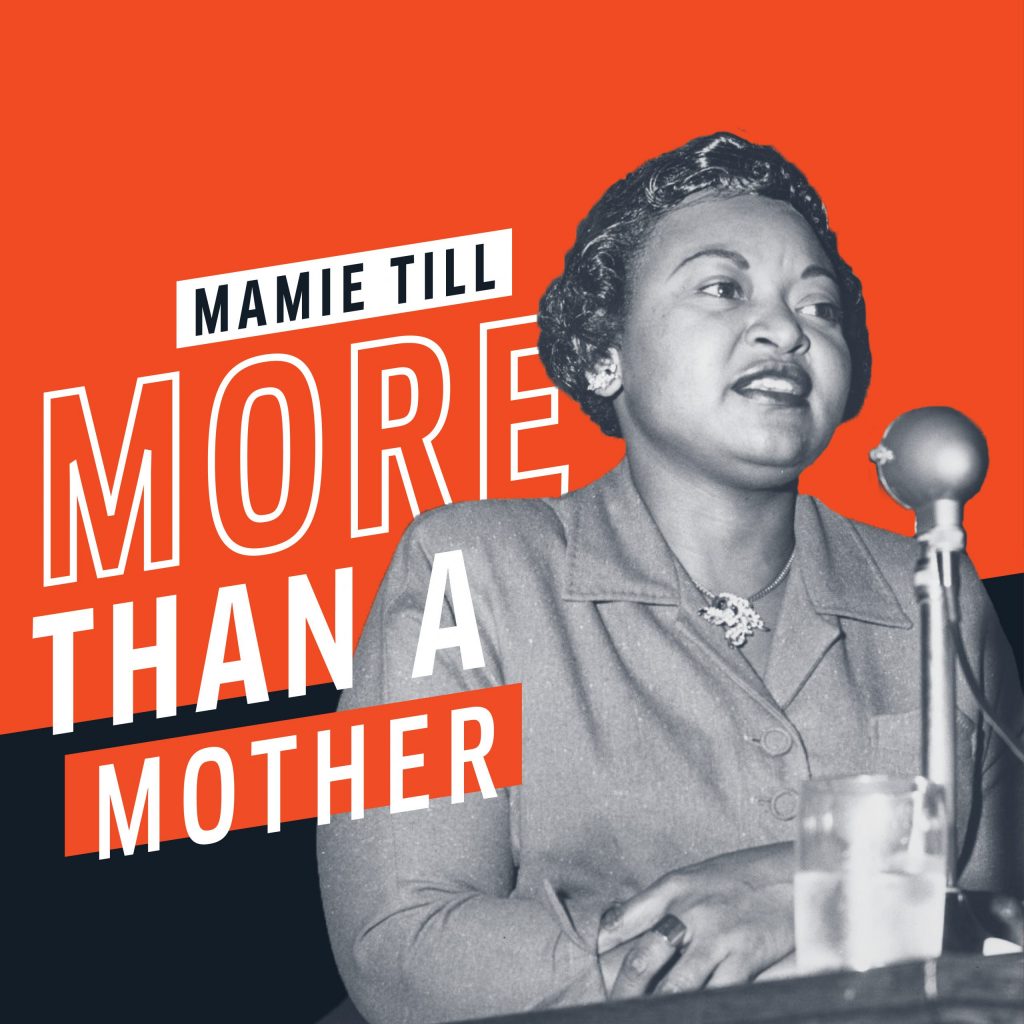
In August 1955, Mamie Till-Mobley tragically became an agent of change when her 13-year old son, Emmett, was murdered while visiting family in Mississippi. Till-Mobley’s decision to show her son’s brutalized body in an open casket served for many as a catalyst to act against the injustices perpetuated against African Americans. Seeing graphic images of his corpse in Jet Magazine and the Chicago Defender made it hard for people to ignore the violence being perpetrated against Black bodies. In fact, her own tragedy served as her own wakeup call as she mentioned in one of her speeches: Two months ago I had a nice apartment in Chicago. I had a good job. I had a son. When something happened to the Negroes in the South I said, ‘That’s their business, not mine.’ Now I know how wrong I was. The murder of my son has shown me that what happens to any of us, anywhere in the world, had better be the business of all of us. After her son’s death, Mamie Till-Mobley became an outspoken advocate in the fight for civil rights, speaking to groups around the country with the NAACP, and serving as an advocate for education. As a teacher in the Chicago Public School system for twenty-three years, Till-Mobley worked with young people both inside and outside of the classroom. She also continued to seek justice for her son in the years following his death, lending her voice to various documentaries and writing an autobiography Death of Innocence: The Story of the Hate Crime that Changed America, that was published posthumously. Learn more about Mamie Till and other Fearless Women at The Center. Plan your visit today and experience how we’re more than a museum. STAY CONNECTED WITH THE CENTER & GET THE MOST UP-TO-DATE INFORMATION ON SOCIAL BY FOLLOWING US @CTR4CHR #FEELTHEPOWER
The Time is Right
In this time of medical crisis and instability, please enjoy this reminder that Atlanta is a strong and vibrant community that can rise to the occasion of any inequity or injustice. Since June 23, 2014, when The Center opened, we have shared stories of struggle and triumph throughout the world. One surprise we’ve discovered along the way is, that when our visitors walk through our galleries, they are often inspired to share their stories. W have so many stories, in fact, that we needed the means to begin collecting them—thus, “The Time is Right” project was born. Working with a group of local professional photographers under the name “#weloveatl,” we sought out the stories of Atlantans who have been or are active in the community working for social justice. During the course of the project, we shot 40 portraits and video interviews of folx from all different walks of life: teachers, mayors, students, business leaders, etc. The film, debuting at the 2017Atlanta Celebrates Photography Festival, is a story of hope, dedication, and love for thy neighbor.
JoAnn Robinson: More Than A Teacher
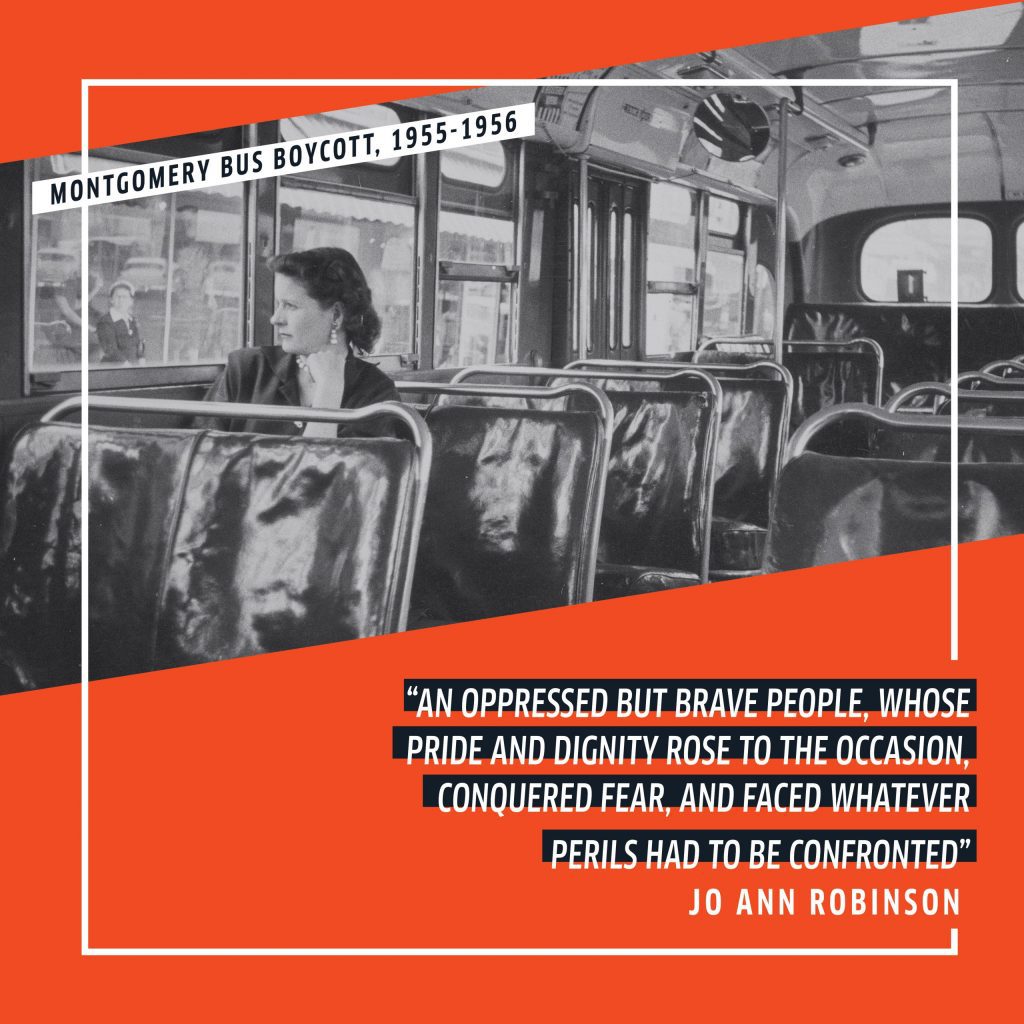
JoAnn Robinson began her career in public service as an educator in Macon, Georgia, working in public schools as an educator. She would go on to earn her master’s degree from Atlanta University and attend Columbia University. A job at Alabama State College for Negroes (now Alabama State University) brought Robinson to Montgomery, where she would join the Women’s Political Council. The WPC was an organization of African American women activists who were faculty of Alabama State College, teachers in the public schools and wives of other African American professionals in Montgomery. These women came together to fight the discrimination and racism African Americans faced on a daily basis. Prior to Rosa Parks’ 1955 arrest, the Women’s Political Council had begun discussing the possibility of a bus boycott. JoAnn Robinson was the WPC president at the time, and met with city officials during 1953 and 1954, pressing them to adopt reforms that would keep segregation in place but no longer require that black passengers surrender their seats to whites. When they received word that Rosa Parks had been arrested the WPC sprang into action. Robinson who was still an English professor at nearby Alabama State College, copied thousands of flyers urging African Americans to boycott buses on the day of Parks’ trial. WPC members canvassed Montgomery’s African American community to spread the word. The one-day boycott proved so successful that the Montgomery Improvement Association (MIA) was formed to direct the movement to change the bus laws. A simple demand that blacks be able to keep their seats evolved into a battle to end segregated buses altogether. The boycott lasted nearly a year, with a U.S. Supreme Court decision finally ruling the Alabama laws unconstitutional. The victory made Martin Luther King, the young president of the MIA, a household name, thanks in large part to the actions and activism of JoAnn Robinson and the Women’s Political Council. Learn more about JoAnn Robinson and other Fearless Women at The Center. Plan your visit today and experience how we’re more than a museum.
National Center for Civil and Human Rights’ IHTI & LGBTQI Partner with Emory University to Launch New Campaign To End Commercial Sexual Exploitation of Youth in Atlanta

Coalition receives $1 million NoVo Foundation grant to advance compreshensive solutions supporting marginalized communities in Fulton County Atlanta, GA (February 24, 2020) – The National Center for Civil and Human Rights’ LGBTQ Institute and International Human Trafficking Institute (IHTI), have partnered with Emory University to develop a new campaign to end commercial sexual exploitation in Atlanta. The initiative seeks to establish a solutions-based program that targets the immediate needs of youth under 25-years old at risk for, or experiencing, commercial sexual exploitation in Fulton County, while also transforming systems to prevent future abuse. The NoVo Foundation awarded the coalition a $1 million grant to launch the program. The funds are part of the NoVo Foundation’s The Life Story Grants, a $10 million, three-year investment in survivor-centered programs in the U.S. that open exit ramps from the sex trade while closing on-ramps. The Atlanta-based project is among 15 projects awarded funding to address systemic failures that allow sexual exploitation of to thrive and harm the most marginalized communities, including girls and women of color, as well as LGBTQ, immigrant, and Indigenous girls and women. The project features a new multi-sectoral partnership between Emory’s Rollins School of Public Health and Barton Child Law and Policy Center; youthSpark; and the National Center Civil for Human Rights’ LGBTQ and International Human Trafficking Institutes. “We are extremely honored that our two human rights institutes—LGBTQ & IHTI, are tapped to bring their research, advocacy and coalition building expertise to this important effort to eradicate modern day slavery,” said Jill Savitt, CEO of the National Center for Civil and Human Rights. The campaign tackles vulnerabilities by expanding youthSpark’s comprehensive model that emphasizes a survivorship over the traditional victim narrative. Its inclusive approach illuminates notions of exploitation, acknowledging the experiences of most at-risk youth of color – particularly Black and Brown youth. Ultimately, the coaltion seeks to build a robust holistic intervention model that improves direct civic services, effects policy, and serves as a replicable resource for other communities. Key strategies and initiatives include: Expanding early intervention systems to widen the safety net for at risk girls – including trans youth – on the commercial sexual exploitation continuum (led by youthSpark); Leveraging the International Human Trafficking Institute’s Metropolitan Atlanta Coalition to End Human Trafficking to strengthen the region’s public-private, community-based response (led by the National Center for Civil and Human Rights International Human Trafficking Institute); Empowering survivor-leaders, including transgender people, to inform project planning and implementation (led by the National Center for Civil and Human Rights LGBTQ Institute); Rigorously evaluating and enhancing the early intervention system and public policies needed to effectively close trafficking on-ramps, minimize barriers to services, and package this evidence-based response into a roadmap for other jurisdictions (led by the Rollins School of Public Health and Barton Child Law and Policy Center); and Disseminating promising practices and scientific research findings to local, state and national human trafficking stakeholders. “IHTI’s multi-sector coalition of private, public, advocacy, philanthropic, multi-faith, and philandropic partners is uniquely positioned to galvanize civic engagement and resources to this effort,” said Deborah Richardson, IHTI’s Executive Director. “We are grateful to receive funding and to help ensure that trans women have a voice in this project that will help inform project planning and implementation,” said Ryan Roemerman, Executive Director of the LGBTQ Institute. Dabney P. Evans PhD, MPH, an associate professor at Rollins and lead investigator on the project said, “Through this collaboration, we are uniquely situated to provide direct services to survivors and at-risk youth, as well as to create the systemic change necessary to end the commercial sexual exploitation of children in Atlanta.” Questions about The Center’s Institutes can be sent to Deborah Richardson ([email protected]) or Ryan Roemerman ([email protected]) as well as on https://thelifestory.org/
Jimmie Lee Jackson: More Than A Protestor
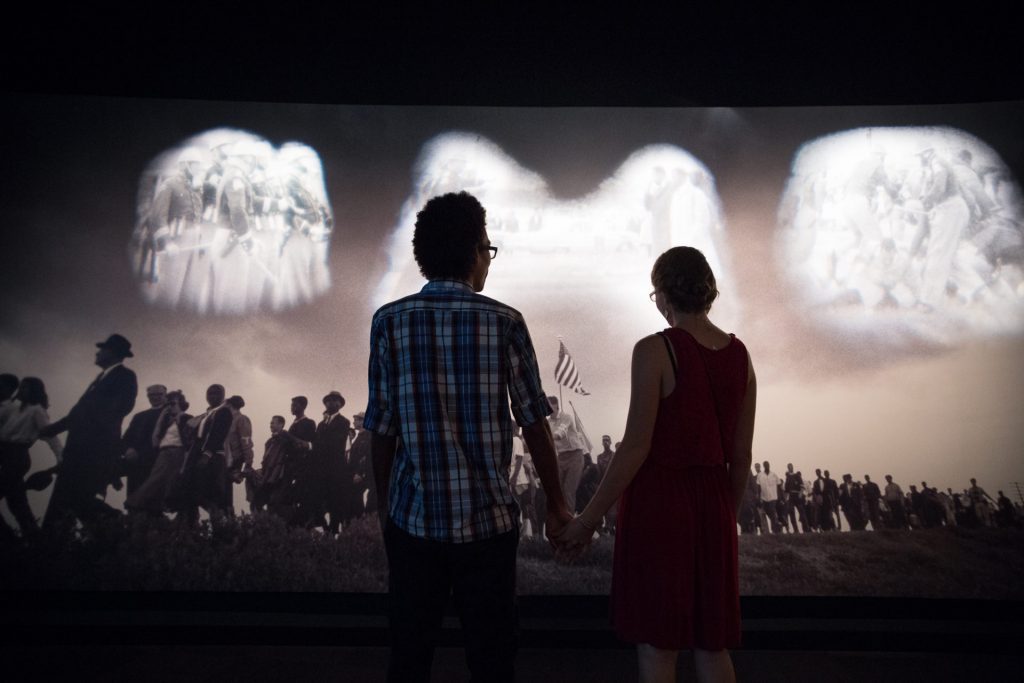
Jimmie Lee Jackson, was a Vietnam veteran, Baptist deacon, activist and martyr of the Civil Rights Movement. Jackson, active in the fight for equal rights, had tried multiple times to register to vote in Alabama and was denied each time. On February 18, 1965, he attended a meeting at Zion Chapel Methodist Church, followed by a vigil in support of recently arrested civil rights activist and reverend, James Orange when state and local police converged upon the vigil and attacked both the participants and members of the national media covering the event. After seeking shelter in a nearby building, and being assaulted by officers, Jackson was shot twice in the abdomen by Alabama State Trooper James Bonard Fowler. He would die eight days later in a Selma hospital. Inspired by Jackson, SNCC leaders organized the first Selma-Montgomery march for voting rights on March 7th. That march resulted in what became known as “Bloody Sunday,” filled with similar violence Jackson and his family faced that evening weeks earlier. The march provoked a public outcry and after three attempts, protesters were able to complete the 50-mile trek. The march, inspired by Jackson, would paved the way for the passage of the 1965 Voting Rights Act. Learn more about Jimmie Lee Jackson and other civil rights icons at The Center. For further reading, check out the Southern Poverty Law Center‘s site for more information. Plan your visit today and experience how we’re more than a museum.
John Lewis: More Than A Congressman
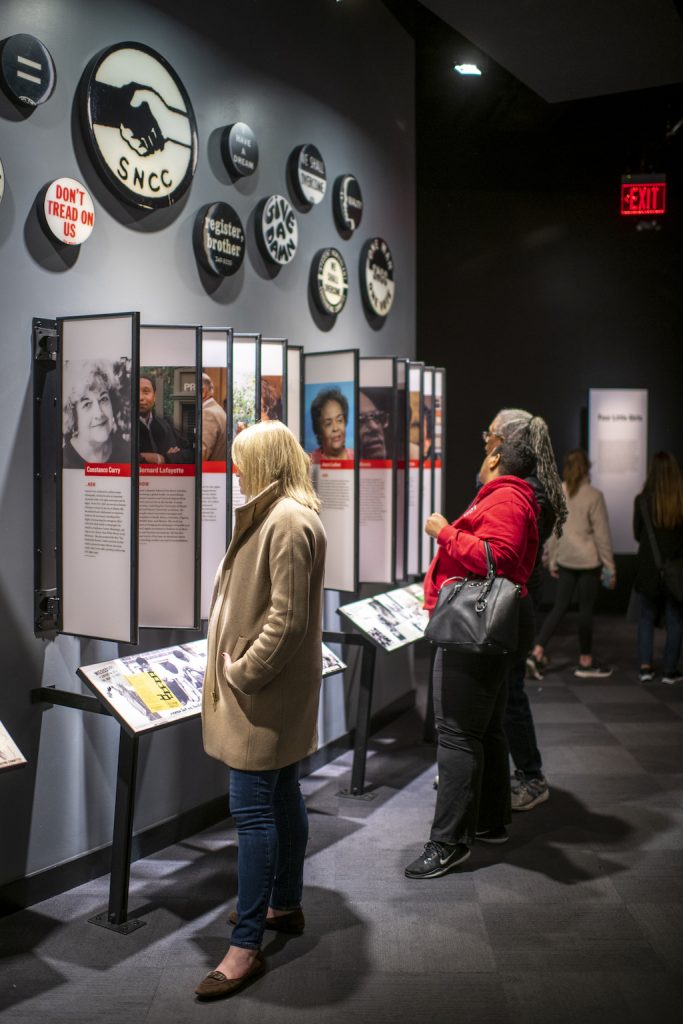
John Lewis has served the public by defending civil and human rights for everyone, from his days as a student organizer with Student Nonviolence Coordinating Committee to the present as the Representative for Georgia’s 5th District. Congressman Lewis was a part of the Freedom Rides, the March on Washington, and Freedom Summer. His support for voting rights in the March from Selma to Montgomery March 7, 1965, led to an attack by state troopers fracturing his skull. The attacks meant to stop Lewis in his tracks could not hold him down, creating a legacy of service to others in the name of equal rights. As the hometown hero of Georgia’s 5th District, Congressman Lewis has been called the “moral conscience of the House of Representatives.” His legacy includes experience as SNCC’s chairman from 1963—1966 as well as serving on Atlanta’s City Council from 1981—1986. Through the American Civil Rights Movement, the philosophy of nonviolence, & contemporary issues, Congressman Lewis is a living testament to how one may “live the legacy.” Learn more about Congressman John Lewis and other civil rights icons at The Center. Plan your visit today and experience how we’re more than a museum.
Ruby Bridges: More Than A First Grader

November 14th will mark the 60th Anniversary of the integration of William Frantz Elementary School in New Orleans by six-year-old Ruby Bridges. Norman Rockwell’s painting, “The Problem We All Live With,” published four years after Ruby Bridges’ brave actions, remains an important piece of Americana. With incredible courage, Ms. Bridges walked amongst white protestors as they hurled slurs while throwing objects at her—because of the color of her skin. Ruby Bridges described the scene like Mardi Gras. However, the lasting effects of her actions that lead to the desegregation of the New Orleans public school system hit her and her family in many detrimental ways. Her father lost his job, and her grandparents were even thrown off of the land they had sharecropped for years. The family’s courage in the midst of racism and bigotry is like many other icons during the American Civil Rights Movement. History now sees Ruby Bridges as more than a first grader, but at the time she was one of many everyday people making incredible strides to push the needle towards progress in America. Learn more about Ruby Bridges and other civil rights icons at The Center. Plan your visit today and experience how we’re more than a museum.
National Center for Civil and Human Rights and Porsche Celebrate 71st Anniversary of the Universal Declaration of Human Rights with Free Admission to The Center

Atlanta, Ga. (October 17, 2019) – The National Center for Civil and Human Rights (The Center), with support from Porsche Cars North America, Inc. (PCNA), will waive admission on Saturday, October 26 to commemorate the 71st anniversary of the United Nation’s Universal Declaration of Human Rights (UDHR). This is the second year Atlanta-based PCNA has sponsored a free day at The Center for the public. “The vision to create a framework of global rights and freedoms for every human being through the Universal Declaration of Human Rights is one that Porsche values,” said Klaus Zellmer, President and CEO of PCNA. “We are proud to be able to support our neighbor, The Center, in celebrating and protecting human rights around the world.”The Universal Declaration of Human Rights (UDHR), adopted on December 10, 1948 in the aftermath of World War II, established the principle that human rights are universal and that every segment of society has a responsibility to uphold them. The UDHR’s 30 articles outline these rights—from the right to free speech and voting to the right of an education and access to health care.“We treasure our collaboration with Porsche because it allows us to celebrate human rights, and educate more people on how to protect these rights,” said Jill Savitt, CEO of The Center. “This year, we are focused on urging young people to tap into their own power to change the world. Porsche’s support helps us provide free admission so we can reach and inspire more people.” PCNA was established on September 1, 1984 and actively supports causes including education, the arts, and civil rights. The Center will host a series of events covering multiple civil and human rights topics. Activities include Eleanor Roosevelt’s Celebratory Brunch (and bust installation), “Her Truth, Her Power” Oculus VR exhibit, Love Beyond Walls Dignity Museum launch, and much more. For more information and a full program schedule please visit www.civilandhumanrights.org/fall-19. About the National Center for Civil and Human Rights The National Center for Civil and Human Rights in downtown Atlanta is an engaging cultural attraction that connects the American Civil Rights Movement to today’s Global Human Rights Struggle. The Center features a continuously rotating exhibit from The Morehouse College Martin Luther King, Jr. Collection, which includes many of Dr. King’s documents and personal items. Visitors are immersed in experiential exhibits through powerful and authentic stories, historic documents, compelling artifacts, and interactive activities. The Center is a source for ongoing dialogue — hosting educational forums and attracting world-renowned speakers and artists who work on a variety of human rights topics. For more information, visit www.civilandhumanrights.org. Join the conversation on civil and human rights on @ctr4chr (Twitter) and @ctr4chr (Facebook). About Porsche Cars North America | One Porsche Drive, Atlanta, GA 30354 USA Established in 1984, Porsche Cars North America, Inc. (PCNA) is the exclusive U.S. importer of the Porsche 911, 718 Boxster and 718 Cayman; Macan and Cayenne; Panamera; and Taycan. Headquartered in Atlanta, Georgia since 1998, PCNA is also home to the first Porsche Experience Center in North America featuring a module-based 1.6 mile driver development track, business center, and fine dining restaurant, 356. The company operates a second Porsche Experience Center near Los Angeles. That 53-acre complex features a driver development track with eight educational modules totaling 4.1 miles, a business center, and Restaurant 917. PCNA supports 191 independently owned and operated Porsche dealerships in the U.S., including supplying parts, service, marketing, and training. They, in turn, work to provide Porsche customers with a best-in-class experience that is in keeping with the Porsche brand’s 70-year history of leadership in the advancement of vehicle performance, safety, and efficiency. PCNA is an indirect wholly-owned subsidiary of Porsche AG, which is headquartered in Stuttgart, Germany. At the core of this success is Porsche’s proud racing heritage that boasts some 30,000-plus motorsport wins to date. Follow us: twitter.com/porsche | facebook.com/porsche For Porsche apps: https://www.porsche.com/usa/apps-and-entertainment/apps/ Shani Drake Director of Marketing and Public Engagement National Center for Civil and Human Rights [email protected] James Richards PR and Communications National Center for Civil and Human Rights [email protected]