
How to be Black

Being a Black woman comes with many different perspectives and hardships, but I never knew I would understand the feeling of pride. This disconnect with issues within the Black community came from my lack of association with Black people. In my teen years, I avoided Black spaces because I decided that I did not fit in. Often, when I was in those spaces, I was made fun of for my voice or my lack of knowledge of Black culture. Recently, my dad told me that they often kept me out of those spaces so that I would not have to grow up like my parents did. This is an understanding decision on my parents’ part, but I also ended up creating quite the antipathy for the Black community. Ideas such as “Why can’t they just uplift themselves?” or “Black people are tearing themselves apart, not the government,” were often in my head. The lack of acceptance in one space allowed me to create a toxic reality downplaying the actuality that many grievances from the Black community towards the “System” were, in fact, real. I was caught in the middle of a battle with my own identity when the Black Lives Matter movement arrived on the University of Virginia (UVa) Grounds in the Winter of my Third Year. In the moment, I was the token Black friend of a rather large, White friend group. When the movement came, I didn’t know who I was. I knew I was Black but not that Black. I was privileged to not experience many hardships, but I felt connected to the pain in a way my friends never could nor would understand. This later created a chasm in our friendship and sadly those people are no longer in my life. Yet, I’m glad they were because they helped me recognize the problematic aspects of my attendance at UVa. I walked into college trying to get an Electrical Engineering degree for the money and left with an African American and African Studies degree to enrich my mind with my history. Now, as someone who is trying to be a more active participant in the fiber of change in America, I constantly remember the words of W.E.B. DuBois and understand that to be Black in America is to be a Problem. Being Black feels like this often, but I know I can do more and hope that it ripples out and touches more than just the Black community, but all of America.
What’s in a Name?

Author of this blog post, Kelly Crosby, is a Gallery Assistant at the Center for Civil and Human Rights. What’s in a name? Apparently, everything. I’ve had many interesting conversations with visitors as a gallery assistant. One day, I was in the Morehouse Martin Luther King Jr. Collection with a group of grade school students. We currently have on display original documents detailing the correspondence between Dr. Martin Luther King Jr. and various African leaders and activists. Inside one of the display cases is a party invitation from Ghana. One of the students, a young girl, approached me with a very thought-provoking question. “Why does the party invitation say, “Mr. Martin Luther King and Mrs. Martin Luther King?” I explained to her that in those days, when a woman married, she was often referred to by her husband’s full name. I also explained that it was a common practice. I could only describe the look on her face as incredulous. For a grade school girl, she couldn’t understand why a woman would be obligated to change her name. She also didn’t understand why she would be referred to by her husband’s full name. But that short conversation made me think about women’s identity and how it has been shaped and molded in American culture. For most of human history, at least in most Western societies, women were expected to take their husband’s last name; signaling the abandonment of her “maiden” status for her new marital identity and allegiance to her husband’s family. For us, in our modern-day society, where feminism and women’s rights are common topics, these documents are stark reminders of a not-too-distant past. In the 1970s, the trend of hyphenated names appeared and gave women more options in choosing how to express their identities. Our culture still reflects these trends. While most American women still change their names upon marriage, joined surnames of the wife and husband, are a popular option. It is no longer an assumption that a woman will take her husband’s last name but a choice. Such choices reflect the woman’s choice to shape her own individual identity. And in some states, like California and Georgia, men can legally change their last names on the basis of marriage. Because of these changes, we know Mr. King’s wife as Coretta Scott King. In her book, “My Life, My Love, My Legacy,” she says, “Most people who have followed my career from afar, or even given me a second thought, know me as Mrs. King: the wife of, the widow of, the mother of, the leader of. Makes me sound like the attachments of a vacuum cleaner. In one sense, I don’t mind at all. I’m proud to have been a wife, a single parent, and a leader. But I am more than a label. I am also Coretta.” Because of her husband’s famous legacy, many forget that she was a great civil rights activist in her own right. Our center is a beneficiary of her effort to preserve her husband’s important documents. She continued her efforts to fight for racial equality and was active in the women’s rights movement. She was also a major critic of South African apartheid and an advocate for LGBT civil rights. The efforts of women and men to struggle for women’s rights has made it possible for us to see women as autonomous individuals in their own right—not simply as someone’s mother or wife. Prior to this, the efforts of women like Coretta Scott King, Diane Nash, Claudette Colvin and Dorothy Height were often overshadowed by the men they worked along side with. We have been able to look back and reexamine history to see these women as crucial to the American Civil Rights struggle rather than women on the periphery of that movement. We’ve come a long way but still have a long way to go before all woman can be respected and valued as individual human beings.
The Detour and My Foundation
Torrie Shepard is the Marketing and Communications intern at The National Center for Civil and Human Rights. Standing Room Only is a weekly blog series that follows Torrie’s journey from bystander to upstander. I was an engineering major at the University of Virginia before I decided that breaking my spirit, over and over, for a non-existent passion was not for me. I set out to change majors the summer before my third year, only finding a more complicated journey ahead of me. In order to switch into the major I wanted (Media Studies) I had to have a “fill-in” major because I was a Third Year student. My only choice became my salvation—African American and African Studies (AAS). Don’t get me wrong, I was planning to drop the major once I was able to get into the Media Studies department and start pursuing my dreams of becoming a film producer. Yet, the difficulty of getting into the Media Studies major caused me to stick with AAS and thus began my appreciation for my Blackness and my need to understand how history has etched the ongoing record of the Black experience in America. My close mind soon became opened. Yet, I still think I projected the same idea that my history was stuck in the past and it was time for reconciliation and rejuvenation. My history taught me otherwise; I learned so much about redlining and other institutional methods to keep people of color outside of the American dream. It hurt my head and my heart. It explained why somehow my roommates (all White Women) had wealth and I did not, even though our parents made the same amount of income. How modern slavery ties to incarceration and why I should care. It would be hard to tell you that I have never wished to live beyond the Veil, but after getting my degree, I am glad to live within so many intersections of social identity.
Lessons from the Lunch Counter
Sometimes the reality of history can feel unbelievable, not in a way that makes you question if past events truly happened, but how actual people lived and fought through them. This past semester, I took an African American History class. What we read in a textbook or watch in a documentary often failed to capture the intensity of firsthand experience, so to deepen our understanding of the struggle for civil rights, my professor, Dr. Walker, led our class in a debate game called Reacting to the Past. Each student took on a character based on different Civil Rights activists at the 1963 Dorchester Retreat in Dorchester, Georgia. I was assigned the role of a staffer for the Student Nonviolent Coordinating Committee who had taken part in freedom rides and other nonviolent protests like swim-ins and sit-ins. But it wasn’t until the beginning of this summer, during my first trip to the Center for Civil and Human Rights, that I was able to grasp the sheer fortitude that nonviolent protesting requires. I sat down at the lunch counter simulation. Following the directions, I put on the headphones, placed my hands on the counter, and closed my eyes. As the voices swelled from behind, my hands began to sweat, my back stiffening against the recorded sneers. Instinctively, I began assuring myself, “This is not real, you’re in a museum.” Then, at a certain point, I broke. I couldn’t keep my eyes shut anymore. I had stopped breathing when the violence around me increased. I kept the headphones on and my hands plastered on the counter, but I stared into the mirror in front of me to sustain a level of detachment from the simulation. They, the resilient warriors of the Civil Rights Era, couldn’t tell themselves, “This is not real.” They sat down, braced themselves, and fought a powerful war without an ounce of force. Getting up from the lunch counter, I felt unworthy to have taken on the role of a SNCC staffer in Dr. Walker’s class without having willingly survived the same brutality. But I also felt a deep sense of solidarity and reverence, a culmination of sorts. Something was instilled into my spirit that day: a measure of strength before unknown.
The Mustard Seed
Torrie Shepard is the Marketing and Communications intern at The National Center for Civil and Human Rights. Standing Room Only is a weekly blog series that follows Torrie’s journey from bystander to upstander. STANDING ROOM ONLY: The Mustard Seed (Part 1) THERE WERE TOO MANY VOICE TO COUNT and not enough happening in the amphitheater at the University of Virginia on a chilly, spring night. It was a spattering of students, teachers, and part of the Charlottesville community convening in a town hall to discuss the brutal arrest of Martese Johnson by Virginia Department of Alcohol and Beverage Control officers on March 18th, 2015. All I could remember was that, if I showed up maybe someone would give me direction on what to do and from that I would make a change. Instead I stood on the sidelines and observed what soon became a confusing protest that, at the time, I believed had done nothing to help anyone. This was the first time I felt that I could have done more but instead decided to be stationary. Two years later, I graduated and started volunteering. I’ve become more interested in service and intend to start doing better for my environment. Yet, to be honest, I still have a long road ahead of trying to live a service-oriented lifestyle. This is Standing Room Only; a girl seeking a seat with the activists but instead has found herself on the sidelines.
Celebrating the Powerful Women of the Center for Civil and Human Rights
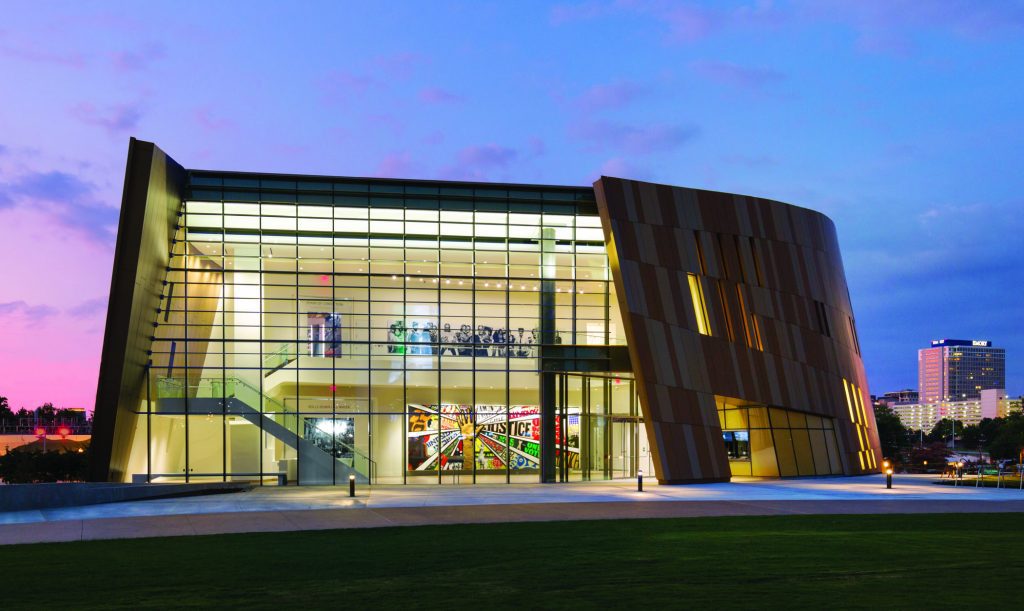
On this last day of Women’s HERstory Month, I wanted to honor some very important women to the City of Atlanta. The city is home to many attractions and the Center for Civil and Human Rights is the moral center of our culture. For almost three years now, The Center helped inspire and empower a spirit of self-determination and resilience in the global community, as informed by the Civil and Human Rights Movement of which Atlanta is world renown. Each and every day we witness more people come to see the history of civil and human rights both nationally and internationally. The CENTER has found its place in the noble history of Atlanta and now finds itself poised to become one of the top attractions not only in Atlanta, but throughout the United States. The question then becomes what is behind this incredible success? The simple yet principled answer is the Women Power of The Center’s staff. These women are integral in running an attraction, museum and Center of intellectual discourse all in one. The reason why this is especially unique is that most of the work that makes The Center highly ranked is typically held by males. Roles like Chief Financial Officer, Facilities Manager, Director of Visitor Services, Manager of Education and Exhibits and so many more essential positions to The Center are held by the strongest of females. As the CEO of the organization, I can tell our visitors and friends that I have found this women power to represent more than a gender diversity and inclusion principle. Rather, I see the performance of my female counterparts as representing the best people for the job. Without the extensive professional expertise, empathy and sympathy of my fellow colleagues, I don’t think The Center would have enjoyed such early success given the incredible pressure we face everyday to keep its doors open. I am proud of these women for their abilities because they are real and they are changing the world as we know it. I want to take this opportunity to celebrate and the Powerful Women behind the scenes at the Center for Civil and Human Rights during this month of March and throughout the year. Thank you to the Women of The Center; keep setting the bar high!
Brown vs. Board of Education: Rewind and Fast Forward by Keisha Lewis
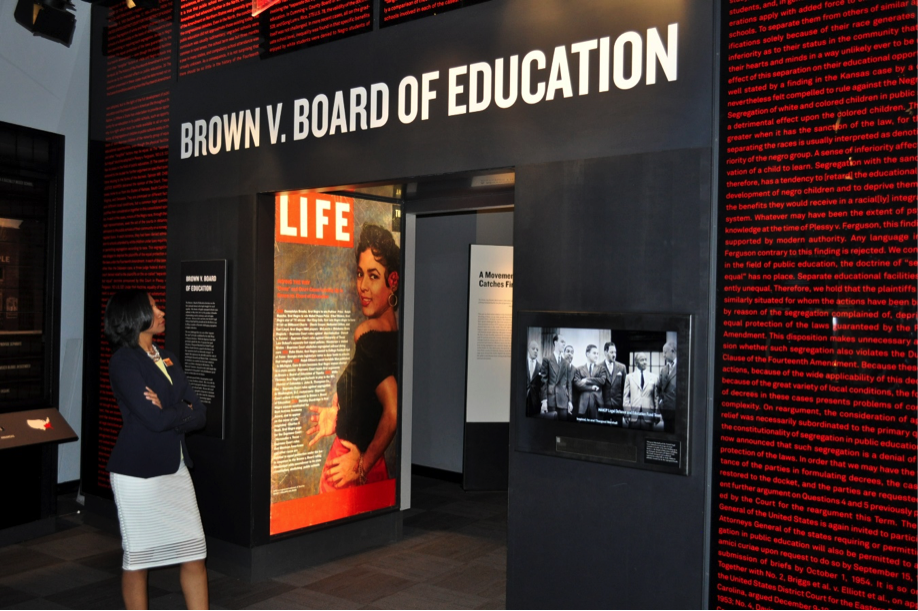
Author of this blog post, Keisha Lewis, is the Director of Visitor Services at the Center for Civil and Human Rights. As I arrived at work, busses unloaded anxious middle school students eager to begin their field trip. As each student stepped off the bus I reflected on my time in middle school and the friends I made along the way. I thought about my social media connections/friends and the diversity in race and gender among these groups. I contemplate being in the high school marching band, making so many friends and not feeling alienated by my race or gender. My mind drifted to how I was able to obtain these relationships (meanwhile the kids at The Center are freely talking to one another as they enter the building). After a morning Operations meeting, I began a morning walkthrough of The Center. I stopped at The Brown vs. Board of Education exhibit and thought of my mother’s and courage in the 1960’s as the “Movement Catches Fire”. I reminisced back to when I was 13 years old, sitting on my mother’s bed after school and asked a question that would spark my curiosity for years. “What was it like for you in school, mom?” She told my sister and I that school was fun and that she learned a lot up until 1967 – her Junior Year in High School. During that year, she was pulled into a room with about 13-14 other students at Lemon Street High, the only school Black youth could attend up until then. Adults briefed the students on integrating with white students at a new High School in Cobb County (which is ironically my Alma Mater). Brown vs. Board of Education changed her life forever, as well as mine. The day the students were integrated, she was taunted as she stepped out of the van delivering them to this unfamiliar school filled with unfamiliar faces. She was called a “Nigger”, spat on and a sign was taped to her back without her knowledge that read, “Since when do Niggers have red hair?” I could go on and on but for sake of time I will leave it at that. Although she was horrified by these experiences, she continued to hustle up her pride and return to school every day for months. For years, it unsettled me that I did not understand the full story of why people were so hateful to her so when I made it to College my journey began. My obsession with knowing more about the American Civil Rights Movement led me to earn a B.A. in History with a concentration in Civil Rights and a focus in Brown vs. Board of Education/integration. None of this could happen before literally taking a walk down memory lane with my mother as she walked me through what remained of Lemon Street High School. My mother recounted how black businesses in Marietta thrived before desegregation and how she didn’t finish high school because it became too hard to take. Did I mention that the bus she rode to school would not return them home some days so that black students on her street were forced to walk many miles home? Many people ask me “Why history? It’s so boring.” My answer is now: this “boring” history was my mother’s reality. Our mother’s story transformed me and my sister’s perspective on history. My sister Mia, determined to teach and obtain the highest level within the Education field, earned her Doctoral degree in Education. I am currently the Director of Visitor Services at the Center for Civil and Human Rights. You never know how someone else’s story can impact your life! I believe in celebrating the unsung pioneers of a movement and inspiring others to see how they can make a difference. Forward! Keisha Lewis Director of Visitor Services
Women and Politics with Adrienne White: New Episode of Rights Not Reserved

Adrienne White, VP of Finance at The National Center for Civil and Human Rights, talked with us about Women and Politics on our latest episode of our podcast, Rights Not Reserved. Topics include: Adrienne’s transformative experience with Black Girls Run Putting love back into politics Government’s role as counterbalances to market forces Gerrymandering Personalizing bills such as Georgia HB 51 How to get involved in politics The sexism faced by women running for office CLICK HERE TO SUBSCRIBE VIA ITUNES
“Until…”: Telling Stories of Civil and Human Rights through Recycled Materials
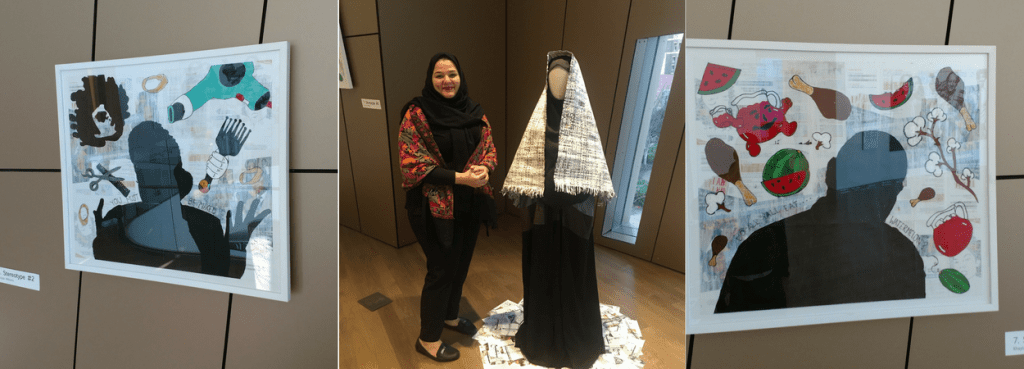
“Until…” is a temporary art display featured inside the Center for Civil and Human Rights through March 11, 2017. The display located on our 3rd floor tells the stories of civil and human rights through recycled CCHR materials. Students of the Savannah College of Art and Design repurposed CCHR brochures into art. Each piece expresses the artists’ personal journey regarding civil and human rights. Topics include stereotypes, social protest, and the “Spirit Hand” of aboriginal artists. This project is in partnership with Savannah College of Art and Design professor V. Elizabeth Turk and the Associate Chair of Photography Michael O’Brien. The display may be seen during The Center’s hours of operation. Click here for tickets.
Let’s Foster Both Love and Human Rights on Valentine’s Day

Author Deborah Richardson is the Senior Advisor for Partner Engagement of The National Center for Civil and Human Rights Two of the most prevalent symbols of Valentine’s Day are chocolate and roses. However, if you have not visited the Center for Civil and Human Rights, you may not know that these two items, especially to meet the high volume created by Valentine’s Day, are responsible for egregious labor exploitation of women and vulnerable children. Seventy percent of roses sold in the United States are imported from Ecuador. Human rights groups and universities have documented the horrific working conditions of the women in Ecuador who toil long hours in the fields. According to the New York Times, “due to repeate exposure to the pesticides used to produce high quality roses, women in the industry had more miscarriages than average and that more than 60 percent of all workers suffered headaches, nausea, blurred vision or fatigue (Thompson 2003).” These health risks are in addition to the very low wages that keep their families impoverished. The harvesting of cocoa beans is especially troubling as seventy percent of the workers are children in West Africa. Major chocolate companies have been under fire by both Congress and consumer groups since 2001 to end their practices of recruiting and hiring child labor. Activists report that chocolate companies have repeatedly missed the deadlines that they agreed to. In a story by the CNN Freedom Project, they share the story of Abdul, who was recruited to pick cocoa beans after his mother died when he was seven. At the time of the story Abdul was 10 years old, had no formal education, and had performed this grueling work for over 3 years. The sad irony is that Abdul had never tasted chocolate. We have freedom to choose how we spend our dollars, however, we can make choices where our consumerism isn’t tied to the explicit exploitation of others. Flowers grown locally can be found with a web search, and there are certainly many creative options of gifts to express your love and care for your special someone. It will be an even greater demonstration of affection knowing that it wasn’t given by taking away the freedom of others.