
Silencing the Shame with Shanti Das

Season 2 Episode 1 of Rights Not Reserved We open up season two discussing mental health and the stigmas that often comes from dealing with those issues with Shanti Das. Das is the founder of Silence the Shame, a mental health initiative under her Hip-Hop Professional Foundation. In this episode the three of them discuss Das’s personal triumphs over mental health, the shame and stigmas surrounding getting help, and what you can do to help silence the shame. National Silence the Shame Day is May 5th. Learn more about what you can do to help here. If you or anyone you know is in need of a crisis line text SILENCE to 741741 or call the National Suicide Prevention Lifeline at 1-800-273-TALK(8255). Click here to subscribe to Rights Not Reserved. Listen to the episode below:
Women in Diversity
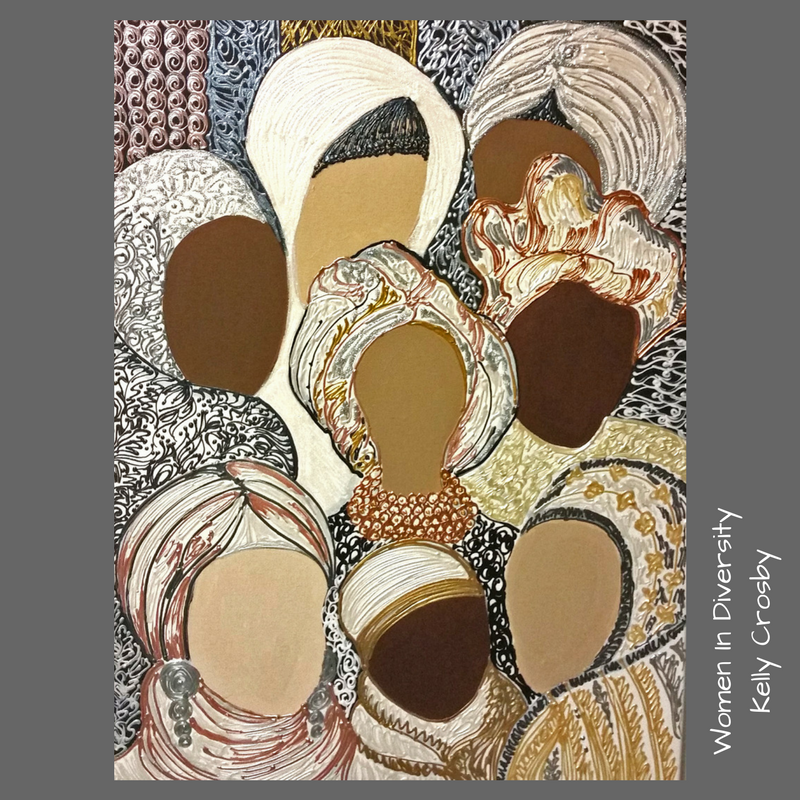
As an emerging artist, I was very happy to have my artwork chosen for a special collection of merchandise in The Center’s gift shop. For Women’s History Month, The Center selected my painting, Women in Diversity. It’s painting of a group of Muslim women. They’re all wearing headscarves. The headscarf, otherwise known as the hijab, is worn by Muslim women around the world. Their complexions are in various shades of brown. To complement to the neutral tones of their skin, I chose to paint their headscarves in creamy whites and metallic colors. Depending on the culture and religious interpretations, the hijab is worn in many different ways. Some are around wrapped around the head and neck in a traditional-style veil, some are wrapped like a turbans. Some wear their scarves to cover their faces, leaving only the eyes exposed. The hijab is often a source of contention in some parts of the world, interpreted as something that is forced upon women against their will. Countries like Saudi Arabia and Iran have a legally enforced dress code that requires women to cover their bodies. On the flip side, some Muslim-majority countries have banned the veil under the pretext of promoting modernity and curbing terrorism. Turkey had banned women from wearing head coverings in universities and public buildings until 2013. In Chad, the veil was banned in reaction to two suicide bombings in 2015. However, in most Muslim countries, there are no laws enforcing or banning the hijab. It’s quite normal to see Muslim women in all types of dress; fully covered from head to toe or wearing tank tops and yoga pants. For those Muslim women who choose cover, the hijab has become a symbol of faith and fashion statement. The freedom of choice has lead to the creation of a booming Islamic fashion industry, attracting the promotion of large retailers like Macy’s. What I aim to achieve in this work is to break down stereotypes. I wanted to show the wonderful range of colors in humanity. That’s why I chose to include women in different colors. Women of color are underrepresented in the media and in the art world. I also wanted to challenge prevailing notions about Muslim women and the hijab. Rather than show Muslim women as passive and oppressed, I wanted to show us beautiful, fashionable and empowered–like the women I’m very blessed to know. I’m a firm believer in the power of art to educate and inform. I hope my work can be used to promote understanding and break down barriers between different cultures.
FedEx Sponsors Free Admission to the Center for Civil and Human Rights April 4th, 2018

FOR IMMEDIATE RELEASE FedEx Sponsors Free Admission to the Center for Civil and Human Rights April 4th, 2018 to Commemorate the 50th Anniversary of the Assassination of Dr. Martin Luther King, Jr. ATLANTA, March 27, 2018 – The Center for Civil and Human Rights announces its plan for the 50th Commemoration of the Assassination of Dr. Martin Luther King, Jr. Courtesy of the generous support of FedEx, admission to the Center for Civil and Human Rights in Downtown Atlanta will be free on April 4th, 2018 with extended hours from 9:00AM to 7:30 PM. “On April 4th, I invite Atlanta to come to The Center to reflect on the life of Dr. King and transform the way we live his legacy every day,” said Brian Tolleson, Interim CEO of the National Center for Civil and Human Rights. “Dr. King’s vision, courage and commitment to service inspired people from all walks of life,” said Shannon A. Brown, senior vice president and chief human resources and diversity officer at FedEx Express. “FedEx is honored to celebrate Dr. King’s extraordinary legacy by offering free public admission to the National Center of Civil and Human Rights.” Along with free admission, The Center will host a day of activities that challenges visitors to continue the legacy of Dr. Martin Luther King, Jr. Activities include: Live the Legacy Photo Booth 9:00 AM to 7:30 PM on the Second Floor Main Lobby Share how you Live the Legacy of Dr. Martin Luther King, Jr. and inspire your peers to take human rights personally on social media with a photo booth. “Atlanta: Living the Legacy” Art Exhibition 9:00 AM to 7:30 PM on the Second and Third Floors Savannah College of Art & Design students created art pieces that explore the rapid development and growth of the City of Atlanta and the role Atlanta plays in living the legacy of Dr. King. “I’ve Been to the Mountain Top” Performances 1:00, 2:00 and 3:00 PM in the Glenn Room on the First Floor Austin Broughton performs Dr. Martin Luther King, Jr.’s “I’ve Been to the Mountain Top” speech. Global Bell Ringing Ceremony 7:01 PM on the Second Floor Main Lobby Guests will join people around the world to commemorate the official moment of the commemoration of Dr. King’s assassination at 7:01 with a Bell Ringing. For more information visit civilandhumanrights.org or call 678.999.8990. About the Center for Civil and Human Rights The Center for Civil and Human Rights in Downtown Atlanta is an engaging cultural attraction that connects The American Civil Rights Movement to today’s Global Human Rights Movements. The Center features a continuously rotating exhibit from The Morehouse College Martin Luther King, Jr. Collection, which includes many of Dr. King’s documents and personal items. Visitors will be immersed in experiential exhibits through powerful and authentic stories, historic documents, compelling artifacts, and interactive activities. The Center is a source for ongoing dialogue — hosting educational forums and attracting world-renowned speakers and artists who work on a variety of human rights topics. For more information, visit www.civilandhumanrights.org. Join the conversation on civil and human rights on Twitter @Ctr4CHR and Facebook. About FedEx Corp. FedEx Corp. (NYSE: FDX) provides customers and businesses worldwide with a broad portfolio of transportation, e-commerce and business services. With annual revenues of $64 billion, the company offers integrated business applications through operating companies competing collectively and managed collaboratively, under the respected FedEx brand. Consistently ranked among the world’s most admired and trusted employers, FedEx inspires its more than 425,000 team members to remain “absolutely, positively” focused on safety, the highest ethical and professional standards and the needs of their customers and communities. To learn more about how FedEx connects people and possibilities around the world, please visit about.fedex.com. Media Inquiries: Kristie Cain Raymer, [email protected], 404-835-4281 # # #
AND STILL WE RISE
Women. We are mothers, wives, sisters, professors, caregivers, providers. But we are also artists, activists, educators, authors, civic leaders, “game changers” and “rule-breakers”. We coined the term“Badass”. We are more than just a hashtag. More than just a fleeting conversation about activism and equal treatment. We are women. This March, we celebrate the simple complexity of women across the globe. This March, the Center for Civil and Human Rights invites you to celebrate the strength and resiliency of women through our public programs and community dialogues. #DEFIANTACTIVISM On Wednesday, March 14th The Center and The Atlanta Opera had an evening of performance and reflection with our preview opera performance, Out of Darkness: Two Remain. The performance encompasses two heart wrenching true stories, set during the German holocaust. One of those stories, other highlights the life of political prisoner and poet Krystyna Zywulska. Her provocative poems became anthems of hope for those imprisoned in Auschwitz. #METOO + #TIMESUP Although it is the 3rd month of our year, 2018 has started out with one thing in mind: retribution. On March 24th, The Center will host a community dialogue with Oscar-winning actress and human-trafficking activist Mira Sorvino. Sorvino will share her story of activism and why she decided to speak out against one Hollywood titan, Harvey Weinstein. This program has been made possible by the generous donation of Delta Air Lines. #WOMENINGREEN #WOMENINSTEM Today, the STEM industry is the wave of the future. Smart phones, home assistants, even alarm systems are all fueled by careers STEM. All things considered, women still remain underrepresented in STEM professions, but that narrative is changing. To celebrate the contributions of women, we are honored to partner with the United States Green Building Council for The Center’s first Women in Green luncheon. Held on Thursday, March 29th, we will hear from a few of today’s elite women in STEM and learn how they used their brain power to power the globe. In addition to these public programs our Education Department is working with several Affiliate Partner Schools to deliver specialized lessons on women in leadership during the Civil Rights Movement. These lessons will culminate with a talk at The Center with activist and MacArthur fellow, Maria Varela. Her work as an organizer, educator, writer, and photographer started as a member of the SNCC staff from 1963 to 1967. The Center is proud to elevate stories of women, who lead in the global movement for change. Many women are household names, like Rosa Parks. Others are unsung SHEroes like Jo Ann Robinson. No matter how loudly their names ring like the bells of justice, we shine light on their accomplishments. In the words of former Montgomery Alabama Women’s Political Council President Jo Ann Robinson, “People the world over should know that any group, if given equal opportunity in education, employment, civil rights and the like, can be desirable citizens anywhere, with as much to offer as any other group.” We are pleased to present a variety of programs which are as diverse, full of depth and complexity as we are. We rock, we shine, we Rise.
The National Center for Civil and Human Rights announced the departure of CEO, Derreck Kayongo
The National Center for Civil and Human Rights today announced the departure of CEO, Derreck Kayongo. Mr. Kayongo is departing to pursue other endeavors. The Center’s Board Chair, former Atlanta Mayor Shirley Franklin said, “Together, we have built the Center for Civil and Human Rights into a world-class institution. Operationally, we have recently paid off all of the financing for constructing our current permanent collections and for the building itself. On behalf of the entire board, we wish Derreck great success in his future plans. We are well-positioned and excited for the next phase of our growth.” Also today, The Center announced the hiring of a new Chief Operating Officer, Donald Byrd and Director of Finance, Lavette Dow-Jones. Mr. Byrd, also a CPA, embodies more than 35 years of experience in executive, finance, accounting, management, business growth and business development experience for domestic and international enterprises. Mr. Byrd comes to The Center from his previous role as COO at Vista Realty Partners. Board Member of the Center for Civil and Human Rights, and President of Central Atlanta Progress, A.J. Robinson, “I have had the privilege of knowing Don both professionally and personally for over three decades. From our many successful years working together in the Portman Organization, I’ve seen first-hand Don’s strategic and long-range approach to growing top-notch operations. We are very fortunate to add his expertise to the professional staff at The Center.” The National Center for Civil and Human Rights also proudly announced another new hire, Ms. Lavette Dow-Jones, as Director of Finance. Mrs. Dow-Jones joins the new operations team, reporting to Mr. Byrd, from her most recent position as Director of Finance and Administration at The Robert E. Greenleaf Center for Servant Leadership. During a short transition following Mr. Kayongo’s departure, Center Board Member and Founder of The LGBT Institute, Brian Tolleson, currently CEO of digital content agency, BARK BARK and partner at Lexicon Strategies, will serve as Interim CEO. Mr. Tolleson is already well versed in The Center’s strategic plan and will assist The Center by continuing to advance The Center’s goals and initiatives. About the Center for Civil and Human Rights The Center for Civil and Human Rights in Downtown Atlanta is an engaging cultural attraction that connects The American Civil Rights Movement to today’s Global Human Rights Movements. The Center features a continuously rotating exhibit from The Morehouse College Martin Luther King, Jr. Collection, which includes many of Dr. King’s documents and personal items. Visitors will be immersed in experiential exhibits through powerful and authentic stories, historic documents, compelling artifacts, and interactive activities. The Center is a source for ongoing dialogue — hosting educational forums and attracting world-renowned speakers and artists who work on a variety of human rights topics. For more information, visit www.civilandhumanrights.org/. Join the conversation on civil and human rights on Twitter @Ctr4CHR and Facebook. Media Inquiries: Kristie Cain Raymer, [email protected], 404-835-4281
International Women’s Day: The Power of One Woman
Today is an important day around the world: It’s International Women’s Day! You might not know this but in many countries around the world this day is so important that it is a National Holiday and the goal is to stop and reflect as well as pay homage to the contributions of women around the world. One such country is Uganda where I originally come from. Uganda isn’t known for doing many things well, but on this Day it must be celebrated for marking this important day as a national holiday. But they go further. They actually give out a National Medal of honor to a particular woman who has exhibited exemplary work empowering women all over the nation. So guess who won this noble award on this propitious today? None other than my mother Ms. Miriam Kayongo! She was among the first women to create the Uganda Women’s Secretariat which was responsible for elevating the needs of women on the national stage. To do that, Ms. Kayongo spent years traversing the Country educating and mobilizing women into micro finance, girl’s education, fighting against sexual harassment and getting women elected into cabinet positions and leadership both in government and elsewhere. This is one example of the power of one woman to change the lives of not just women but also their households. Today Uganda is better because of Ms. Kayongo’ s redoubtable work and I am very proud of my Mummy!!! Happy International Women’s day to you all and I hope some of you can also share your mother’s contributions to society and elsewhere.
Let’s Refresh Our Community’s Response to Child Sex Trafficking

Author Deborah Richardson is principal of Deborah Richardson & Associates dedicated to empowering organizations and their leaders to actualize their mission. Connect with her via LinkedIn The City of Atlanta and Fulton County have been on the forefront of America’s efforts to address child sex trafficking. In 2001, a group of women community leaders spearheaded a 16 month effort that led to the passage of Georgia’s first trafficking legislation which made pimping and pandering a child a felony. Further, these women raised $1m to open the first safe house for sexually exploited girls east of the Mississippi. Over the past 15 years, there have been many other efforts addressing the issue. In 2016, Georgia’s legislature passed Rachel’s Law which recognized children arrested for sex crimes would be treated as victims rather than criminals. Then, a campaign by the Safe Harbor Yes Committee motivated Georgia voters to approve a constitutional amendment creating a dedicated revenue source to fund services for victims of trafficking. Like all worthwhile efforts, there comes a time to evaluate impact. Many are familiar with The Story of the River. If not, please allow me to refresh your memory: THE STORY OF THE RIVER Once upon a time there was a small village on the edge of a river. One day a villager noticed a baby floating down the river. The villager quickly swam out to save the baby from drowning. The next day this same villager noticed two babies in the river. He called for help, and both babies were rescued from the swift waters. And the following day four babies were seen caught in the turbulent current, then eight, then more, and still more! The villagers organized themselves quickly, setting up training teams of swimmers who could resist the swift waters and rescue babies. Rescue squads were soon working 24 hours a day. And each day the number of helpless babies floating down the river increased. The rescue squads were now snatching many children each day. While not all the babies (now very numerous) could be saved, the villagers felt they were doing well to save as many as they could each day. One day, however, someone raised the question, “But where are all these babies coming from? Let’s organize a team to head upstream to find out who’s throwing all of these babies into the river in the first place!” Despite the continuing efforts of our community’s non-profit organizations, donors, volunteers, law enforcement and elected officials, why have the trafficking numbers not seen a significant decrease? In 2016, the National Human Trafficking Hotline, operated by the Polaris Project, received 692 calls of suspected trafficking from Georgia. Twenty-four percent of these calls were from trafficking victims. Georgia ranks number seven in the amount of calls to the hotline throughout the country. Georgia Cares, the statewide agency that coordinates trafficked victim services , received calls regarding trafficking victims from 101 counties—63% of the state. Is it time to organize a team to head upstream? There are two strategies for this team to consider. First, we now know the social conditions that make children vulnerable to recruitment by traffickers—poverty, frail families, poor school performance, and the absence of positive adult support and guidance. We also know that children in foster care are particularly at-risk. The National Center for Missing and Exploited Children reported that over 90% of the calls received in 2017 concerned children in the foster care system. Second, traffickers are successful due to a demand for sex with children, primarily from adult males. If the demand is eliminated, the trafficking business fails. A long term goal is a shift in how men are socially constructed to view women as objects to buy or coerce for their pleasure. However, an immediate goal is utilizing law enforcement to make it very risky for men to engage in the illegal activity of child sexual exploitation. Reverse stings, where the buyer is arrested and then exposed by publicizing his name and mug-shot is one effective tactic. Technology can also play a role. YouthSpark is coordinating an initiative called Demand Tracker, where an interested party (i.e. prospective employer) can go online and input a telephone number. Then an email, returned to the interested party from the site, identifies whether this number is in the database of those who attempted to make an illegal sex purchase. If any community can truly eradicate child sex trafficking, with our strong civil and human rights heritage, metro-Atlanta is the one that will do. First, let’s invest in initiatives that keep children healthy in mind, body and spirit while insuring their long-term success through completing high school with a clear post-secondary path. Then, send a clear message that those purchasing sex from children will be arrested, exposed and prosecuted. These two steps will stem-the-tide of child sexual exploitation. After all there is much evidence that “an ounce of prevention is better than a pound of cure.”
Rights Not Reserved Episode 15: 2017 Wrap-Up

Erin and Catherine talk about their favorite moments from 2017 and their goals for Rights Not Reserved in 2018. Also, hear from other Center for Civil and Human Rights staff reflect on the past and new year. Thank you for a fantastic first season! Stay tuned for the first episode of season two coming Spring 2018. Click here to subscribe to Rights Not Reserved. Listen to the episode below:
Rights Not Reserved Episode 14: Taking a Stand, Taking a Knee
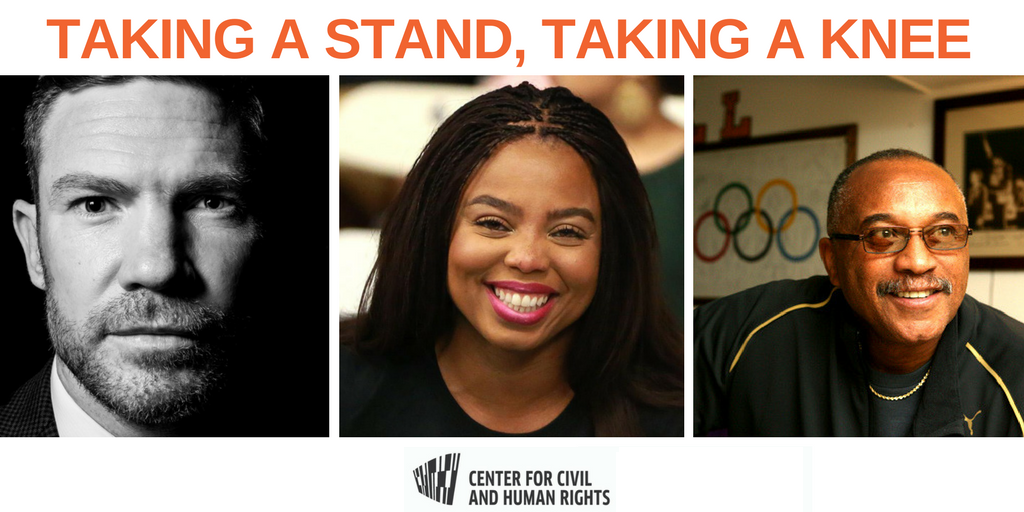
[vc_row][vc_column][vc_column_text css=”.vc_custom_1515695033428{margin-bottom: 0px !important;}”]Our first episode of the new year is a discussion with sports journalist Jemele Hill, 1968 Olympian Dr. Tommie Smith, Ex-army Green Beret and NFL Player Nate Boyer, and Curator of African American Collections at Emory University and our Breaking Barriers: Sports for Change exhibit Dr. Pellom McDaniels. We discuss how civil and human rights are important today from a sports activist perspective. Click here to subscribe to Rights Not Reserved. Listen to the episode below:[/vc_column_text][vc_raw_html]JTNDaWZyYW1lJTIwc3R5bGUlM0QlMjJib3JkZXIlM0ElMjBub25lJTIyJTIwc3JjJTNEJTIyJTJGJTJGaHRtbDUtcGxheWVyLmxpYnN5bi5jb20lMkZlbWJlZCUyRmVwaXNvZGUlMkZpZCUyRjYxMzkzNTQlMkZoZWlnaHQlMkY5MCUyRnRoZW1lJTJGY3VzdG9tJTJGYXV0b3BsYXklMkZubyUyRmF1dG9uZXh0JTJGbm8lMkZ0aHVtYm5haWwlMkZ5ZXMlMkZwcmVsb2FkJTJGbm8lMkZub19hZGR0aGlzJTJGbm8lMkZkaXJlY3Rpb24lMkZiYWNrd2FyZCUyRnJlbmRlci1wbGF5bGlzdCUyRm5vJTJGY3VzdG9tLWNvbG9yJTJGZjI2NTMxJTJGJTIyJTIwaGVpZ2h0JTNEJTIyOTAlMjIlMjB3aWR0aCUzRCUyMjEwMCUyNSUyMiUyMHNjcm9sbGluZyUzRCUyMm5vJTIyJTIwJTIwYWxsb3dmdWxsc2NyZWVuJTIwd2Via2l0YWxsb3dmdWxsc2NyZWVuJTIwbW96YWxsb3dmdWxsc2NyZWVuJTIwb2FsbG93ZnVsbHNjcmVlbiUyMG1zYWxsb3dmdWxsc2NyZWVuJTNFJTNDJTJGaWZyYW1lJTNF[/vc_raw_html][/vc_column][/vc_row]
It Ain’t Easy Being Green- Part One

Many have heard the phrase, “It ain’t easy being green.” With the rising cost of eco-conscious items, being “green” isn’t cheap either. In our ethical footprint section of The Center, we discuss various ways how we as consumers can make better choices in the products we buy. But have you ever noticed that shopping for ethical and sustainable products tends to cost more money? “Apparently being green costs a lot of green. Forty-two percent of those surveyed stated that they do not live a completely green lifestyle because it is too expensive. Another 70 percent stated that they will only buy eco-friendly products if they cost the same or less than non-green products, RetailMeNot reports.” As a consumer who is striving to use my money for social and economic justice, I don’t mind spending more money on a product produced through ethical means. Buying a fair trade chocolate bar means that I’m supporting cocoa farmers and ethical food production. As consumers, we are also voting with our dollars in the goods we refuse to buy. By choosing fair trade items and products, we’re choosing not to buy goods produced with exploited labor. However, the challenge to ethical shopping is that most Americans have limited incomes. There is a constant battle between buying what is ethical and what is inexpensive. And it follows that the less money you have, the more you will buy cheaper but unsustainable and/or unethical goods. For most people this is done out of necessity. People in impoverished communities are trying their best to obtain the necessities of life within their limited incomes. But contrast this reality with some of the luxury sustainable neighborhoods that have popped up within the last decade. In a recent search for eco-friendly housing, I found a house for sale. It had one bedroom and one and a half bathrooms with an open floor plan measuring 900 sq ft. The house was EarthCraft and Geothermal certified. It was energy-efficient and operated on a renewable energy grid. The house was located in an area with easy access to farms where organic fruits and vegetables were sold. Ideally, all of our houses should be this eco-friendly. But the price of the home was $340,000. With rising income equality, a house like this is out of range and simply impractical for most Americans. Unfortunately, it is those living below the poverty line that needs these products and services the most. It’s a well-known fact that impoverished communities tend to have higher concentrations of pollution. These communities also tend to be food deserts–lacking grocery stores, farmers’ markets or healthy food sellers. So what can we do? Why isn’t the eco-friendly and ethical standard the norm? How can we pursue social justice and earth-friendly lifestyles when corporations have a premium on these goods and services? We have to put pressure on corporations to adapt the ethical and eco-friendly model to all of their goods and services. In the next blog post, I will look into why green living costs so much and what we can do to make green living feasible and more affordable for all of us.